Saw palmetto is a small palm native to the southeastern United States. Its berries have been used for centuries in traditional medicine, and today it's widely studied for two primary applications: benign prostatic hyperplasia (BPH) and androgenetic alopecia.
What Is Saw Palmetto?
Saw palmetto is a small palm native to the southeastern United States. Its berries have been used for centuries in traditional medicine, and today it's widely studied for two primary applications: benign prostatic hyperplasia (BPH) and androgenetic alopecia.
The active compounds are fatty acids and phytosterols extracted from the berry. These compounds are thought to inhibit 5-alpha reductase — the enzyme responsible for converting testosterone into DHT.
The DHT Problem in Hair Loss
To understand why saw palmetto is of interest for hair loss, you need to understand 5-alpha reductase.
There are two types:
- Type I — found primarily in skin and sebaceous glands
- Type II — found predominantly in hair follicles and the prostate
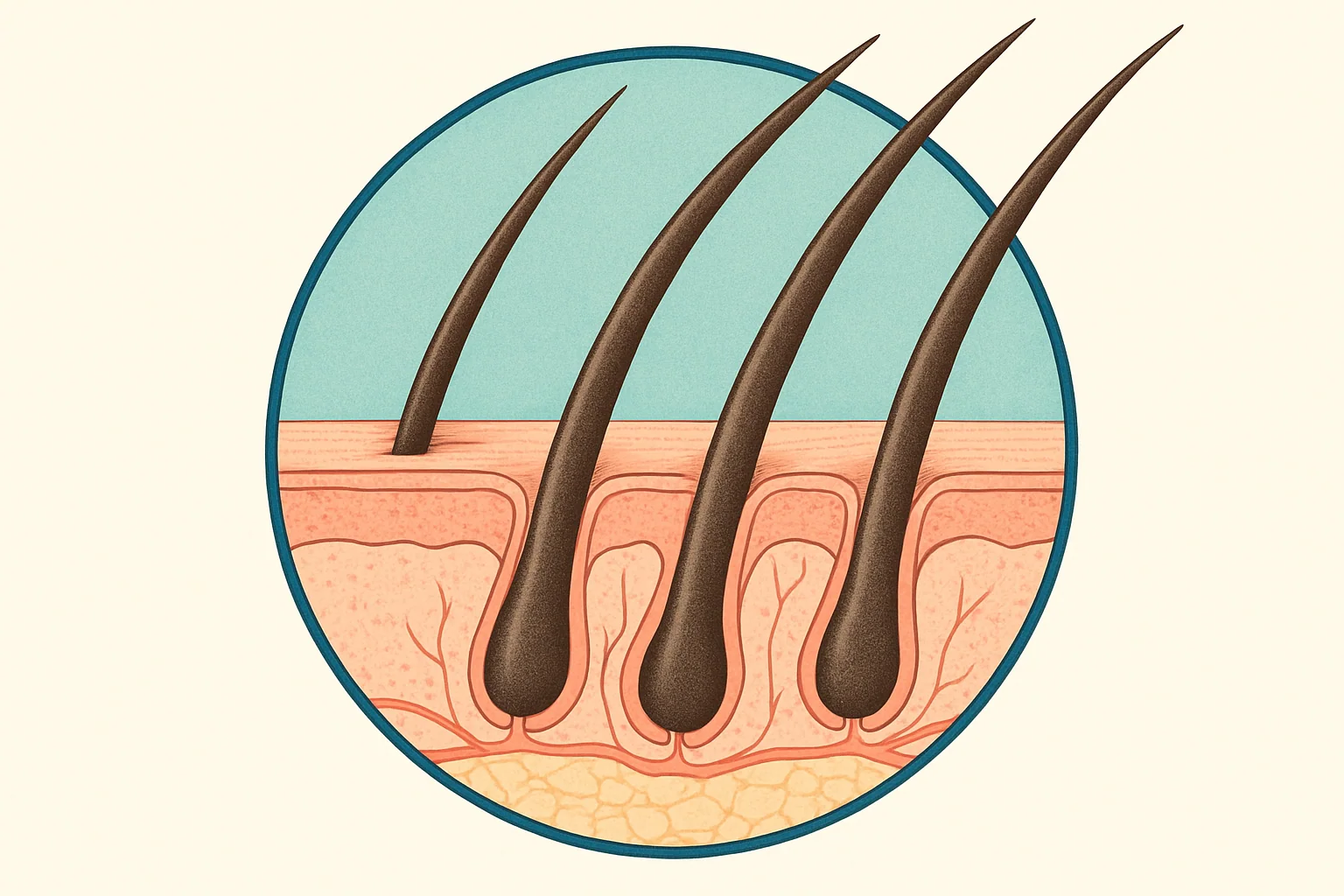
When 5-alpha reductase converts testosterone to DHT, DHT binds to androgen receptors in genetically susceptible hair follicles. This binding signal triggers follicle miniaturisation — the root cause of AGA.
Finasteride, the most prescribed oral treatment for AGA, works by blocking Type II 5-alpha reductase. Saw palmetto is hypothesised to inhibit both types, though with meaningfully lower potency.
What Does the Research Say?
The Rossi 2012 Study — The Key Clinical Reference
The most frequently cited controlled study comparing saw palmetto to finasteride was published by Rossi et al. in the International Journal of Immunopathology and Pharmacology (2012). In this two-year trial:
- 100 men with mild-to-moderate AGA were randomised to receive either finasteride 1 mg/day or saw palmetto 320 mg/day
- After 24 months, 68% of finasteride users showed increased hair growth in the vertex area
- 38% of saw palmetto users showed improvement in the same area
- Both groups showed improvement versus baseline; neither showed significant adverse effects
What this tells us: Saw palmetto underperformed finasteride significantly — but 38% of participants showing measurable improvement over two years is not trivial. For men who cannot or choose not to take prescription DHT blockers, it represents a meaningful option worth considering.
It's also worth noting: the Rossi study measured vertex (crown) improvement. Saw palmetto's effect may vary by area and AGA stage.
Other Supporting Research
A 2020 randomised controlled trial published in JAMA Dermatology (Evron et al.) tested topical saw palmetto versus topical minoxidil 3% and found comparable efficacy at 12 months for mild AGA, with minoxidil outperforming at higher grades.
A 2021 systematic review in Dermatology and Therapy assessed 7 studies and concluded that saw palmetto "may represent a safe and effective option for AGA" particularly in early-stage disease, while acknowledging that head-to-head data against finasteride remains limited.
How Does Saw Palmetto Compare to Prescription Options?
| Saw Palmetto | Finasteride | Minoxidil (topical) | |
|---|---|---|---|
| Mechanism | 5-AR inhibition (I & II) | 5-AR inhibition (II) | Vasodilation / follicle prolongation |
| Evidence grade | Moderate | Strong | Strong |
| Prescription required | No | Yes | No (topical) |
| Response rate (vertex, 24 months) | ~38% (Rossi 2012) | ~68% (Rossi 2012) | ~60–70% (various) |
| Key side effects | Minimal reported | Sexual dysfunction risk (~2–3%) | Scalp irritation, systemic absorption |
| Suitable for early-stage AGA | Yes | Yes | Yes |
This table is illustrative. Individual results vary, and no supplement or medication should be started without discussing your health profile with a qualified clinician.
Who Might Benefit Most?
Based on available evidence, saw palmetto may be most useful for:
- Men with Norwood Scale I–III hair loss (early to moderate AGA)
- Men who want to add a natural DHT blocker alongside other interventions
- Men who have been advised against or choose to avoid finasteride due to side effect concerns
- Men looking to support an existing hair care routine
It is unlikely to be sufficient as a standalone intervention for advanced AGA (Norwood IV+). At that stage, the evidence strongly favours prescription treatments, and early intervention is generally more effective.
Dosage and Form
Clinical studies have predominantly used 320 mg/day of saw palmetto extract (standardised to 85–95% fatty acids). This is typically split into two 160 mg doses taken with food — the fatty acids require dietary fat for adequate absorption.
Most research has focused on oral supplementation. Topical formulations exist but have a smaller evidence base.
The timeline matters: most studies showing positive results ran for 12–24 months. Saw palmetto, like most hair-related interventions, is not a fast-acting solution.
Safety Profile
Saw palmetto has a favourable safety record in published literature. The most commonly reported side effects are mild gastrointestinal symptoms (nausea, diarrhoea) when taken on an empty stomach.
Unlike finasteride, saw palmetto has not been associated with post-finasteride syndrome or meaningful rates of sexual dysfunction in clinical studies to date.
However:
- Saw palmetto may interact with anticoagulant medications (e.g. warfarin)
- It should be used with caution by those with hormone-sensitive conditions
- It is not recommended during pregnancy (relevant for women trialling it for FPHL)
Always consult a healthcare provider before starting any supplement regimen.
The Bottom Line
Saw palmetto is the most researched natural DHT blocker for hair loss. The clinical evidence — including the Rossi 2012 controlled trial — shows real but modest benefit compared to pharmaceutical options. For early-stage AGA, or as part of a multi-modal approach, it represents a credible, well-tolerated option.
It is not a replacement for proven treatments in advanced cases. But if you're in the early stages of AGA and want to understand your options before or alongside prescription therapy, saw palmetto is worth knowing about.
Frequently Asked Questions
Q: Does saw palmetto actually block DHT?
A: Saw palmetto contains fatty acids that inhibit 5-alpha reductase, the enzyme that converts testosterone to DHT. Studies confirm measurable inhibitory activity, though weaker than pharmaceutical 5-AR inhibitors like finasteride.
Q: How long does saw palmetto take to work for hair loss?
A: Published studies showing positive results typically ran 12–24 months. Most clinicians suggest a minimum 6-month trial before assessing response.
Q: Can I take saw palmetto with finasteride?
A: Combining two 5-AR inhibitors is not standard practice, and there is limited data on combined use. Discuss with a doctor before combining any treatments.
Q: What is the standard dose of saw palmetto for hair loss?
A: The most studied dose is 320 mg/day of standardised extract (85–95% fatty acids), typically taken in two divided doses with food.
Q: Is saw palmetto safe for long-term use?
A: Available evidence suggests a favourable safety profile over 2-year study periods. Long-term data beyond this window is limited.
Q: Can women use saw palmetto for hair loss?
A: Some research has explored saw palmetto for female pattern hair loss. However, evidence is less developed than for male AGA, and women of childbearing age should consult a doctor before use due to its hormonal activity.
Q: Does saw palmetto work better than minoxidil?
A: Head-to-head data is limited. The Evron 2020 study found comparable results for mild AGA, with minoxidil showing greater efficacy at higher AGA grades.
Take the Next Step
Noah's AGA formulations are built around the clinical evidence — combining studied ingredients at researched doses, with transparent sourcing and third-party testing.
If you're exploring your options for hair health, visit ofnoah.sg to learn more about Noah's approach to androgenetic alopecia support.
This article is for informational purposes only and does not constitute medical advice. Consult a qualified healthcare professional before starting any supplement or treatment.
Reading about it is a good start.
Talking to a doctor is better. Answer a few questions online and a licensed Noah doctor will take it from there, privately.
Get started
Written by our Editorial Team
Last updated 20 Apr 2026