For a comprehensive guide to hair loss treatment, see our complete guide.
Title: Low-Level Laser Therapy (LLLT) for Hair Loss: Does It Actually Regrow Hair? Target keywords: LLLT hair loss, laser cap hair growth, low-level laser therapy hair, red light therapy hair loss Singapore Word count: ~1,500 CTA destination: ofnoah.sg Schema: Article + FAQPage
If you've spent any time researching hair loss solutions, you've probably come across low-level laser therapy — marketed as laser caps, laser combs, and red-light helmets promising to reverse thinning hair. The devices look futuristic. The claims sound almost too good. So what does the actual science say?
The short answer: LLLT has more evidence behind it than most people realise — but it's not a silver bullet, and it works best as part of a broader treatment plan.
Here's a clear-eyed breakdown of how LLLT works, what the clinical research actually shows, and why it's become a legitimate — if often misunderstood — tool in hair loss treatment.
Low-level laser therapy uses low-powered laser or LED light — typically in the red or near-infrared spectrum (630–670 nm wavelength) — to stimulate biological processes in cells. Unlike surgical lasers that cut or ablate tissue, LLLT doesn't generate heat and doesn't damage the skin.
The mechanism is called photobiomodulation: photons from the laser are absorbed by mitochondria in your cells, specifically by an enzyme called cytochrome c oxidase. This triggers a cascade of cellular events — increased ATP production, improved blood flow, reduced inflammation, and changes in gene expression related to cell growth.
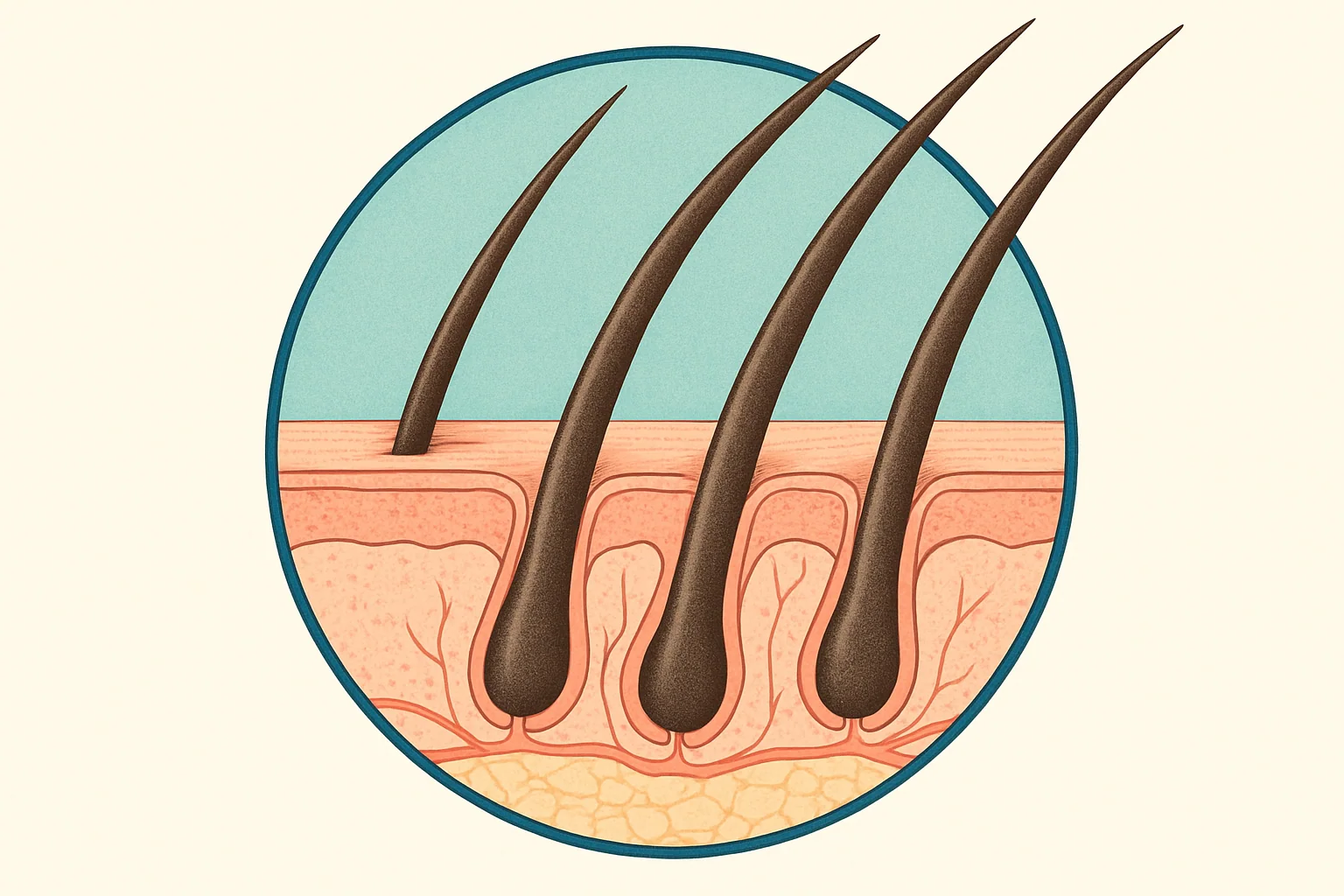
Applied to the scalp, the theory is that this stimulates follicular cells in the telogen (resting) phase to re-enter the anagen (active growth) phase. In other words: it might wake up dormant follicles.
One of the landmark studies on LLLT for androgenetic alopecia (AGA — the most common type of hereditary hair loss) was published in Lasers in Surgery and Medicine in 2013 by Lanzafame and colleagues.
This was a randomised, double-blind, sham-controlled trial involving men with AGA. Participants used a laser device emitting at 655 nm, 30 minutes every other day for 16 weeks. At the end of the study, the treatment group showed a 39% increase in hair count compared to the sham group.
That's a meaningful result — and it was achieved without drugs, without injections, and without side effects beyond occasional mild scalp warmth.
A larger multicenter trial by Kim and colleagues, published in Dermatologic Surgery in 2013, looked at both men and women with AGA over 24 weeks. This randomised, double-blind, sham device–controlled trial found statistically significant increases in hair density in the treatment group.
Importantly, this study confirmed the findings weren't device-specific — the effect appeared consistent across different LLLT modalities, suggesting the photobiomodulation mechanism itself is driving results, not a quirk of any particular product.
It's worth contextualising LLLT against the established treatment landscape for AGA:
| Treatment | Evidence Level | How It Works | Key Limitation |
|---|---|---|---|
| Finasteride (oral) | Strong | Blocks DHT conversion | Systemic, potential hormonal side effects |
| Minoxidil (topical) | Strong | Vasodilation, extends anagen phase | Requires lifelong use; shedding on initiation |
| LLLT | Moderate–Strong | Photobiomodulation | Requires consistent, ongoing use |
| Hair transplant | Strong (surgical) | Relocates follicles | Cost, invasive, doesn't stop progression |
LLLT sits in an interesting middle ground. It has a cleaner side effect profile than finasteride, more mechanistic plausibility than many supplements, and can be used alongside other treatments without drug interactions.
The major catch: it doesn't work overnight. Most studies run for 16–26 weeks, and that's roughly the minimum time frame to see meaningful results. Patience is non-negotiable.
The existing evidence is strongest for:
LLLT is unlikely to help — and no serious researcher claims otherwise — in cases of complete follicular death (severe scarring alopecia), or hair loss from active systemic illness until the underlying cause is treated.
Consumer laser caps and helmets have made LLLT more accessible, but the quality variance is enormous. Not all devices deliver clinically relevant fluence (energy density) or use the optimal wavelength.
Key things to look for: - Wavelength: 630–670 nm or 810–830 nm (near-infrared) - Coverage: Devices that cover the entire scalp, not just a band - Clinical backing: Look for devices tested in peer-reviewed trials, not just marketing materials
In-clinic LLLT sessions typically use professional-grade equipment with higher consistency — though for AGA, the evidence for in-clinic vs. at-home shows comparable outcomes when devices are properly calibrated.
Low-level laser therapy is one of the more credible non-drug options for androgenetic alopecia. The clinical evidence — including the Lanzafame (2013) and Kim (2013) randomised controlled trials — shows real, measurable improvements in hair count and density for people with AGA.
It is not a cure. It won't reverse advanced loss or replace a comprehensive treatment plan. But as part of a multi-modal approach — combined with evidence-based pharmacological options where appropriate — it's a legitimate tool.
The most common mistake people make with LLLT? Giving up after 8 weeks. Hair growth cycles are slow. The evidence-based minimum is 4–6 months of consistent use.
Q: How long does LLLT take to show results for hair loss? Most clinical studies measure outcomes at 16–26 weeks. Don't expect visible changes before the 3-month mark. Consistent use every other day (or per device protocol) is essential.
Q: Is LLLT safe for long-term use? Published studies show no significant adverse effects from LLLT at therapeutic intensities. The light does not damage DNA, does not generate harmful heat, and is considered safe for long-term use. Always follow device guidelines.
Q: Can I use LLLT with minoxidil or finasteride? Yes. LLLT has no known interactions with topical minoxidil or oral finasteride. Many dermatologists recommend combination therapy for synergistic benefit.
Q: Does LLLT work for women? Yes — the Kim et al. (2013) trial included women, and results were statistically significant. Female pattern hair loss (FPHL) responds to LLLT similarly to male AGA, though hormonal considerations differ.
Q: Is LLLT the same as red light therapy? They overlap. LLLT typically refers specifically to low-power laser devices; "red light therapy" sometimes refers to LED-based devices in the same wavelength range. Both can produce photobiomodulation effects when properly calibrated, though laser delivers more coherent light.
Q: How often do I need to use an LLLT device? Most clinical protocols use every-other-day sessions of 20–30 minutes. Daily use is not typically more effective and some protocols suggest alternating to allow cellular recovery.
Understanding the science is the first step. Acting on it consistently is what actually changes outcomes.
Noah combines clinically validated treatments — including options your doctor can assess you for — with the kind of consistent support that makes long-term compliance actually achievable. If you're dealing with androgenetic alopecia and want a proper assessment of where you stand and what's likely to help, start there.
Begin your hair loss assessment at ofnoah.sg →
This article is for informational purposes only and does not constitute medical advice. Consult a qualified healthcare professional for diagnosis and personalised treatment recommendations.