Hair loss is one of those things that creeps up on you. One day you notice slightly more strands on the pillow, and before long you're holding your phone under bathroom lights examining your scalp. If you've gone down the research rabbit hole, you've probably encountered PRP — platelet-rich plasma — positioned as a cutting-edge treatment that uses your own blood to stimulate hair growth.
PRP for Hair Loss: Does Platelet-Rich Plasma Actually Work?
Hair loss is one of those things that creeps up on you. One day you notice slightly more strands on the pillow, and before long you're holding your phone under bathroom lights examining your scalp. If you've gone down the research rabbit hole, you've probably encountered PRP — platelet-rich plasma — positioned as a cutting-edge treatment that uses your own blood to stimulate hair growth.
But does it actually work? Let's look at what the science says, what PRP can and can't do, and how it fits into a wider approach to managing androgenetic alopecia (AGA).
What Is Platelet-Rich Plasma?
PRP is a concentration of platelets derived from your own blood. Here's the basic process: a small amount of blood is drawn, placed in a centrifuge, and spun to separate the components. What you're left with is a fraction of plasma that contains a much higher concentration of platelets than normal whole blood — typically 3–5× baseline levels.
Why does that matter? Platelets are not just about clotting. They're packed with growth factors — proteins that play a signalling role in tissue repair and regeneration. Key ones include:
- Platelet-derived growth factor (PDGF)
- Vascular endothelial growth factor (VEGF)
- Epidermal growth factor (EGF)
- Insulin-like growth factor 1 (IGF-1)
- Transforming growth factor-beta (TGF-β)
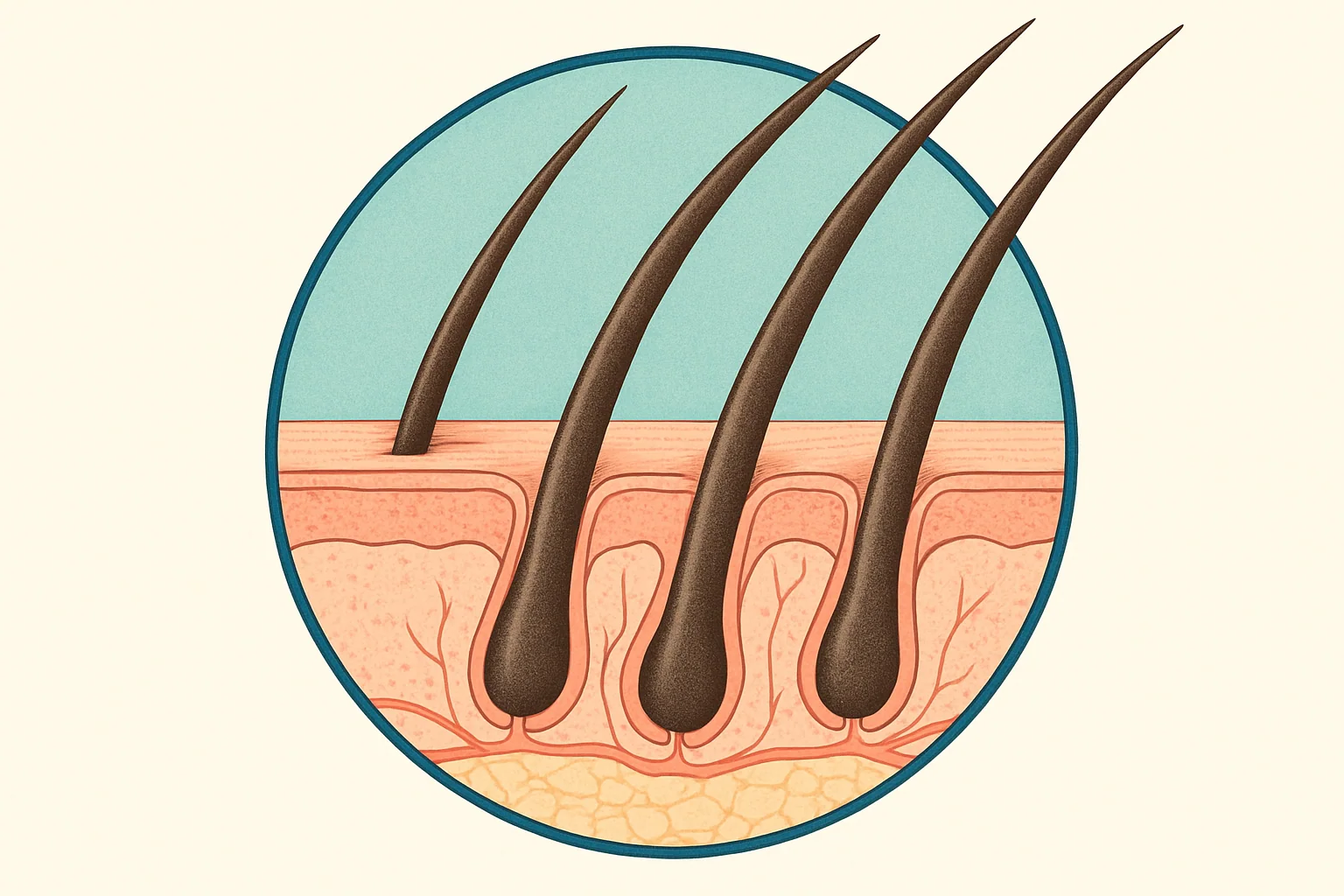
When PRP is injected into the scalp, the theory is that this concentrated cocktail of growth factors creates a more favourable environment around the hair follicle — potentially influencing the follicular cycle and supporting follicle survival in areas affected by AGA.
What Does the Research Actually Show?
This is where things get nuanced. PRP for hair loss has been studied, and there is a body of peer-reviewed work suggesting it may have a role to play — but the evidence base is not uniform.
A widely cited 2018 review by Alves and Grimalt examined the history, biology, and classification of PRP specifically in the context of hair disorders. The authors noted that PRP appeared to stimulate proliferation of dermal papilla cells — the cells at the base of the hair follicle that are critical for hair growth signalling — and that several clinical studies demonstrated improvements in hair density, thickness, and the anagen (active growth) to telogen (resting) ratio in patients with AGA. They also highlighted a key limitation: there is significant variability in PRP preparation protocols across studies, making direct comparisons difficult. Platelet concentration, activation methods, injection technique, and treatment frequency all differ, which affects outcomes.
(Alves R, Grimalt R. Skin Appendage Disord. 2018;4(1):18–24. doi:10.1159/000477353)
Subsequent randomised controlled trials have added to this picture. Studies comparing PRP to placebo (saline injections) and to topical minoxidil have generally shown that PRP produces measurable increases in hair count and thickness, though results tend to be more pronounced in patients in early-to-mid stages of hair loss rather than those with advanced thinning.
The honest summary: PRP shows genuine biological plausibility and clinical signal. It is not a miracle cure, and it works better in some people than others. Standardisation remains a challenge.
Who Is PRP Most Likely to Help?
Based on current evidence, PRP appears most suited to:
- Men and women with early-stage androgenetic alopecia — Hamilton-Norwood Scale I–IV in men; Ludwig Scale I–II in women
- Patients who want to complement other treatments — PRP is increasingly used alongside oral finasteride, topical minoxidil, or low-level laser therapy rather than as a standalone solution
- Patients who cannot tolerate or do not want pharmacological treatment — because PRP uses autologous (your own) material, systemic side effects are minimal
PRP is less likely to help in areas where follicles are completely inactive or in very advanced loss. Think of it as a supportive environment for struggling follicles, not a resurrection of follicles that are already gone.
How Is PRP Treatment Delivered?
A typical PRP hair treatment protocol looks like this:
- Blood draw — usually 20–60 mL from your arm
- Centrifugation — separates PRP fraction (15–30 minutes)
- Activation — some clinics activate platelets with calcium chloride or thrombin before injection; others do not
- Scalp injection — PRP is injected across the thinning areas using a fine needle or microneedling device, typically at 1–2 cm intervals
- Recovery — minimal; most people resume normal activity the same day
An initial course typically involves 3–4 sessions spaced 4–6 weeks apart, followed by maintenance sessions every 3–6 months. Results, when they occur, generally become visible after 3–6 months.
Side effects are usually mild: temporary scalp tenderness, redness, and swelling at injection sites. Because PRP is autologous, the risk of allergic reaction is very low.
PRP vs Other Hair Loss Treatments: How Does It Compare?
It's worth placing PRP in context alongside other established options:
| Treatment | Evidence Level | Mechanism | Typical Use |
|---|---|---|---|
| Oral finasteride | Strong (FDA-approved) | DHT inhibition | AGA in men |
| Topical minoxidil | Strong (FDA-approved) | Vasodilation, follicle prolongation | AGA in men and women |
| PRP | Moderate (growing) | Growth factor signalling | AGA, adjunct or standalone |
| Low-level laser therapy | Moderate | Photobiomodulation | AGA, adjunct |
| Hair transplant | Strong | Follicular relocation | Advanced AGA |
PRP sits between lifestyle approaches and pharmaceutical intervention. It's not a replacement for proven treatments — but it's also not pseudoscience. For many patients, the most effective approach combines a DHT blocker (where appropriate), a vasodilator, and PRP to address hair loss from multiple angles simultaneously.
What PRP Won't Do
It's important to set realistic expectations:
- PRP will not reverse severe or long-standing baldness
- PRP will not work without ongoing maintenance — hair loss is a chronic condition
- PRP results vary considerably between individuals
- PRP is not a substitute for treating the underlying hormonal driver (DHT in AGA) if that's appropriate for you
The goal of PRP is usually to slow progression, improve density in areas of diffuse thinning, and support the health of hair that remains — not to grow a full head of new hair overnight.
The Noah Approach
At Noah, we believe in evidence-led treatment. Hair loss is complex, and the best outcomes come from understanding your specific pattern, stage, and biology — then combining treatments that address it from multiple angles.
Our clinically reviewed protocols factor in the current evidence on PRP alongside oral and topical options, so you're not guessing. Whether PRP is right for you depends on a proper assessment.
Start with a consultation at ofnoah.sg. Answer a few questions about your hair loss, and one of our medical team will review your case and outline what's actually likely to help — no upselling, no generic protocols.
Frequently Asked Questions
Does PRP actually work for hair loss?
Clinical studies, including a 2018 review by Alves and Grimalt in Skin Appendage Disorders, show that PRP can improve hair density and thickness in patients with androgenetic alopecia, particularly in early-to-mid stage loss. Results vary by individual, preparation protocol, and treatment frequency. It is not a guaranteed cure, but it has genuine biological and clinical support.
How many PRP sessions do you need for hair loss?
Most protocols involve an initial course of 3–4 sessions spaced 4–6 weeks apart, followed by maintenance every 3–6 months. Results typically become visible after 3–6 months of treatment.
Is PRP better than minoxidil or finasteride for hair loss?
PRP and pharmacological treatments like minoxidil and finasteride work via different mechanisms. Finasteride and minoxidil have the strongest evidence base and are FDA-approved. PRP is often used as a complement to these rather than a replacement, particularly for patients seeking an adjunct approach or who have contraindications to certain medications.
Is PRP for hair loss painful?
The injections cause some discomfort — typically described as mild stinging. Topical anaesthetic is usually applied beforehand to reduce this. Most patients tolerate sessions well with minimal downtime.
How long do PRP results last?
PRP effects are not permanent. Hair loss is an ongoing condition, so maintenance sessions are required to sustain results. Most patients return every 3–6 months after their initial course.
Who is not a good candidate for PRP?
PRP may not be appropriate for patients with platelet disorders, those on anticoagulant medications, patients with active scalp infection, or those with very advanced baldness where follicles are no longer present. A medical assessment before treatment is essential.
This article is for informational purposes only and does not constitute medical advice. Consult a qualified healthcare professional for personalised guidance on hair loss treatment.
Reading about it is a good start.
Talking to a doctor is better. Answer a few questions online and a licensed Noah doctor will take it from there, privately.
Get started
Written by our Editorial Team
Last updated 20 Apr 2026