If you're losing your hair, a hormone you've never heard of is almost certainly behind it. Dihydrotestosterone — DHT — is a derivative of testosterone that, in genetically susceptible men, systematically destroys hair follicles on the scalp. Understanding how it works is the first step to doing something about it.
Body
If you're losing your hair, a hormone you've never heard of is almost certainly behind it. Dihydrotestosterone — DHT — is a derivative of testosterone that, in genetically susceptible men, systematically destroys hair follicles on the scalp. Understanding how it works is the first step to doing something about it.
This is the complete science.
What Is DHT?
Dihydrotestosterone (DHT) is an androgen — a male sex hormone — that is approximately five times more potent than testosterone. It is not produced directly; instead, it is synthesised from testosterone through the action of an enzyme called 5-alpha reductase (5-AR).
Two isoforms of this enzyme exist in the human body:
- Type I 5-AR: Found primarily in the skin and liver
- Type II 5-AR: Found predominantly in hair follicles, the prostate, and the epididymis
In the scalp, Type II 5-AR is the primary driver of DHT production at the follicular level. DHT then binds to androgen receptors (AR) in the dermal papilla cells — the command centre of each hair follicle — and this binding event is what sets the hair-loss cascade in motion (Kaufman KD, Mol Cell Endocrinol, 2002).
The Follicular Miniaturisation Process
Under normal conditions, a hair follicle cycles through three phases:
- Anagen (growth): Lasting 2–6 years, this is when the hair shaft actively grows
- Catagen (transition): A brief 2–3 week regression phase
- Telogen (rest): A 3-month resting period before the hair sheds and a new cycle begins
When DHT binds to androgen receptors in the dermal papilla, it disrupts this cycle. Specifically, it:
- Shortens the anagen phase — so hairs grow for less time before shedding
- Extends the telogen phase — so follicles spend more time dormant
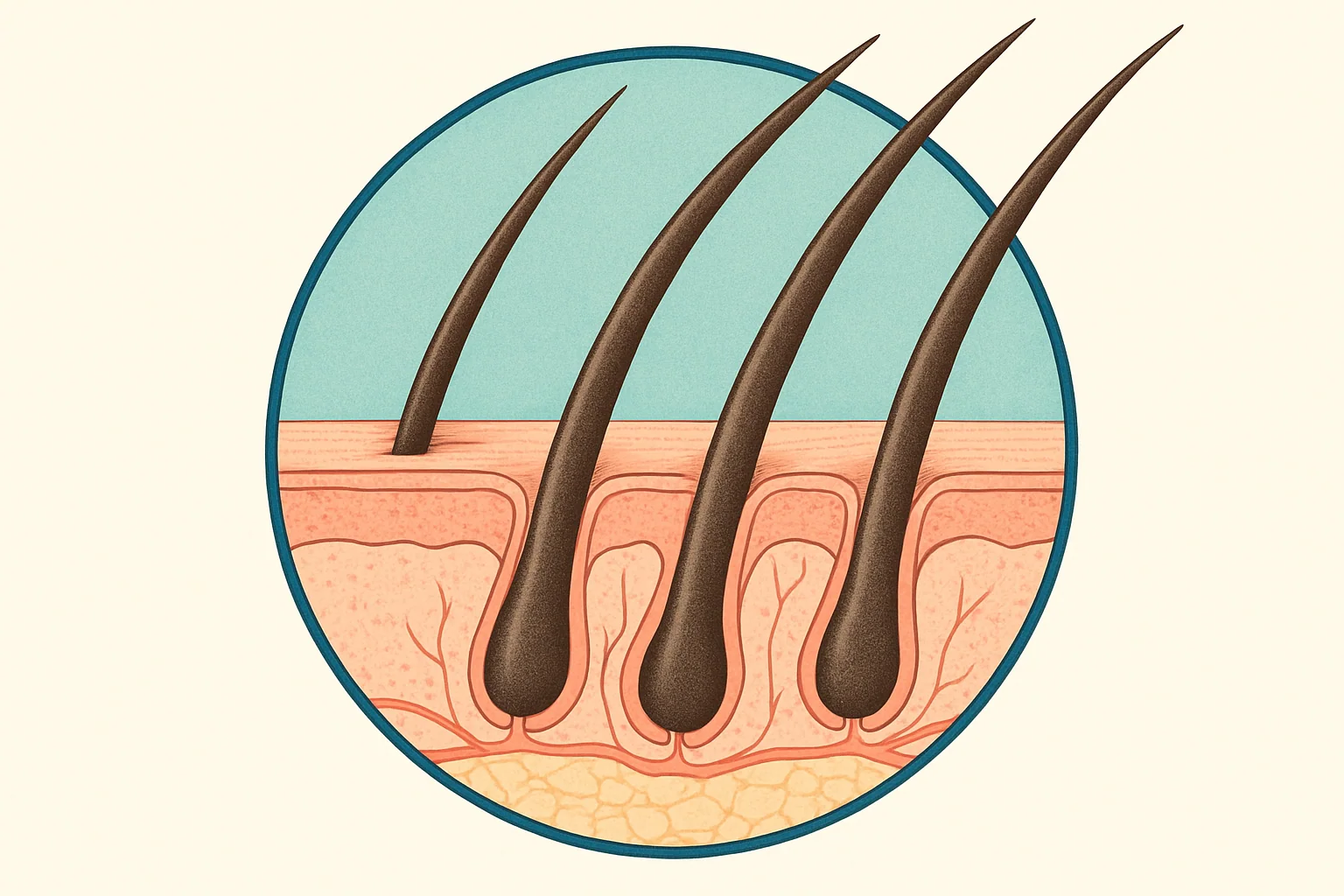
- Progressively miniaturises the follicle itself — each successive hair grows thinner, shorter, and lighter (vellus) until the follicle may eventually stop producing visible hair entirely
This process — called follicular miniaturisation — is the defining biological hallmark of androgenetic alopecia (AGA), the clinical term for male pattern baldness. Critically, the follicle is not destroyed immediately; it shrinks progressively over years, which is why early intervention matters (Ellis JA et al., Expert Rev Mol Med, 2002).
Why Only Some Men? The Genetics of DHT Sensitivity
DHT is present in virtually all men. So why do some go bald and others don't?
The answer lies in androgen receptor sensitivity, which is largely determined by genetics. The gene encoding the androgen receptor (AR) is located on the X chromosome, which explains why male pattern baldness is often described as following the maternal line — your mother's father's hairline is a rough (though imperfect) predictor.
However, AGA is polygenic: dozens of genetic loci contribute to risk, and paternal inheritance also plays a role (Hillmer AM et al., Am J Hum Genet, 2005). Men with highly sensitive androgen receptors in scalp follicles experience more pronounced DHT-driven miniaturisation at equivalent DHT concentrations than men with less sensitive receptors.
This is also why DHT drives prostate growth but doesn't cause scalp hair loss uniformly across the scalp — the follicles on the top and crown carry far more androgen receptors than those on the sides and back. This distribution is why the classic Norwood-Hamilton pattern (receding temples, thinning crown) is so consistent across ethnicities (Norwood OT, South Med J, 1975).
The Evidence That Locked In DHT as the Culprit
The causal link between DHT and male pattern baldness was established long before modern molecular biology. The landmark observation came from researcher Julianne Imperato-McGinley, who studied a population in the Dominican Republic with a rare genetic condition causing Type II 5-AR deficiency. These individuals had very low DHT levels despite normal testosterone — and they did not develop male pattern baldness (Imperato-McGinley J et al., Science, 1974).
Further confirmation came from studies on eunuchs — men castrated before puberty — who were found never to develop AGA regardless of genetic predisposition, since testosterone (and thus DHT) was absent. When given exogenous testosterone later in life, those with genetic susceptibility did develop hair loss (Hamilton JB, Am J Anat, 1942).
These two lines of evidence — one of absence (no DHT = no AGA) and one of administration (add testosterone = AGA in susceptible men) — established DHT as the necessary and sufficient hormonal driver.
5-Alpha Reductase: The Enzyme at the Centre
Because 5-AR is the enzyme that converts testosterone to the far more potent DHT, it became the primary pharmacological target for AGA treatment.
Sawaya and Price (1997) demonstrated that AGA-affected scalp tissue contains significantly higher levels of both 5-AR Type I and Type II, as well as higher concentrations of DHT itself, compared to non-affected occipital scalp in the same individuals (J Invest Dermatol, 1997). This confirmed that the affected scalp zones are not merely more sensitive — they are also locally generating more DHT.
The therapeutic implications are significant: blocking 5-AR reduces local DHT production, allowing follicles that have miniaturised — but not yet been lost — to potentially recover their growth cycle.
How DHT Differs from Other Hair Loss Causes
Not all hair loss is androgenetic. It's important to distinguish AGA from:
- Alopecia areata: An autoimmune condition; DHT-independent
- Telogen effluvium: Diffuse shedding triggered by stress, illness, or nutritional deficiency — generally reversible
- Traction alopecia: Mechanical damage from styling
- Tinea capitis: Fungal infection
AGA is distinguished clinically by its patterned distribution (Norwood-Hamilton scale in men), its progressive and chronic course, and its responsiveness to antiandrogen interventions. A trichologist or dermatologist can confirm diagnosis through clinical examination and, where needed, dermoscopy or trichoscopy to visualise miniaturisation.
What the Science Says About Slowing DHT-Driven Hair Loss
The two most evidence-supported pharmaceutical interventions for AGA both target the DHT pathway:
Finasteride selectively inhibits Type II 5-AR, reducing serum DHT levels by approximately 70%. Multiple randomised controlled trials have demonstrated its efficacy in slowing progression and, in many cases, promoting regrowth in men with AGA (Kaufman KD et al., J Am Acad Dermatol, 1998).
Dutasteride inhibits both Type I and Type II 5-AR, reducing serum DHT by over 90%. Clinical evidence suggests it may produce superior outcomes in some patients compared to finasteride alone (Olsen EA et al., J Am Acad Dermatol, 2006).
Both are prescription medications. Their use, dosing, and suitability must be assessed by a qualified medical professional — side effect profiles and contraindications are individual.
Minoxidil works through a separate, DHT-independent mechanism: it prolongs the anagen phase and increases follicular blood supply. It is often used in combination with DHT-targeting agents for complementary effect (Messenger AG & Rundegren J, Br J Dermatol, 2004).
The Earlier, the More Options You Have
Follicular miniaturisation is a progressive process. Follicles that have miniaturised but retain their dermal papilla can often be stimulated back toward normal cycling. However, follicles that have been in prolonged dormancy — particularly where the follicular unit is no longer visible on trichoscopy — may not respond to medical intervention.
This is why the standard clinical guidance is to address AGA early. The window for medical treatment is widest when miniaturisation is in its early-to-mid stages.
FAQ (AEO Optimised)
Q: What is DHT and why does it cause hair loss? DHT (dihydrotestosterone) is a potent androgen derived from testosterone via the enzyme 5-alpha reductase. In genetically susceptible men, DHT binds to androgen receptors in scalp hair follicles, shortening the growth phase and progressively shrinking the follicle — a process called miniaturisation that leads to male pattern baldness.
Q: Does high testosterone cause hair loss? Not directly. Testosterone itself has a weak affinity for androgen receptors in the scalp. It is the conversion of testosterone to DHT by the enzyme 5-alpha reductase that drives follicular miniaturisation. Men with very high testosterone but low 5-AR activity or low receptor sensitivity do not necessarily develop AGA.
Q: Is male pattern baldness genetic? Yes — AGA is highly heritable and polygenic. While the androgen receptor gene on the X chromosome has the strongest single-gene influence (explaining maternal-line inheritance patterns), dozens of other loci contribute to risk. Both maternal and paternal family history are relevant.
Q: Can DHT-driven hair loss be stopped? Medical interventions that reduce DHT activity (5-AR inhibitors) have clinical evidence for slowing progression and, in many cases, promoting partial regrowth — particularly when started early. No intervention reverses advanced miniaturisation completely. Early assessment by a hair specialist provides the clearest picture of what is possible.
Q: Is the hair loss from DHT permanent? Follicles in early-to-mid miniaturisation can often recover with appropriate intervention. Follicles that have undergone complete fibrosis are generally not recoverable medically. Hair transplant surgery can redistribute DHT-resistant follicles from the back and sides of the scalp to affected areas.
CTA
If you're seeing early signs of thinning, the science is clear: the sooner you understand what's happening, the more options you have.
Noah provides evidence-based hair loss support for men in Singapore — built around the clinical science of DHT, AGA, and what actually works.
Start your hair assessment at ofnoah.sg →
Citations
- Hamilton JB. Male hormone stimulation is prerequisite and an incitant in common baldness. Am J Anat. 1942;71(3):451–480.
- Imperato-McGinley J, Guerrero L, Gautier T, Peterson RE. Steroid 5alpha-reductase deficiency in man: an inherited form of male pseudohermaphroditism. Science. 1974;186(4170):1213–1215.
- Norwood OT. Male pattern baldness: classification and incidence. South Med J. 1975;68(11):1359–1365.
- Kaufman KD, Olsen EA, Whiting D, et al. Finasteride in the treatment of men with androgenetic alopecia. J Am Acad Dermatol. 1998;39(4):578–589.
- Ellis JA, Sinclair R, Harrap SB. Androgenetic alopecia: pathogenesis and potential for therapy. Expert Rev Mol Med. 2002;4(22):1–10.
- Sawaya ME, Price VH. Different levels of 5alpha-reductase type I and II, aromatase, and androgen receptor in hair follicles of women and men with androgenetic alopecia. J Invest Dermatol. 1997;109(3):296–300.
- Hillmer AM, Hanneken S, Ritzmann S, et al. Genetic variation in the human androgen receptor gene is the major determinant of common early-onset androgenetic alopecia. Am J Hum Genet. 2005;77(1):140–148.
- Olsen EA, Hordinsky M, Whiting D, et al. The importance of dual 5alpha-reductase inhibition in the treatment of male pattern hair loss. J Am Acad Dermatol. 2006;55(6):1014–1023.
- Messenger AG, Rundegren J. Minoxidil: mechanisms of action on hair growth. Br J Dermatol. 2004;150(2):186–194.
- Kaufman KD. Androgens and alopecia. Mol Cell Endocrinol. 2002;198(1–2):89–95.
Reading about it is a good start.
Talking to a doctor is better. Answer a few questions online and a licensed Noah doctor will take it from there, privately.
Get started
Written by our Editorial Team
Last updated 20 Apr 2026