If you've started noticing more hair on your pillow or a widening part in the mirror, you may already be Googling what's happening. The Norwood Scale is the most widely used clinical tool for classifying male pattern baldness — and understanding where you sit on it is the first step toward doing something about it.
Norwood Scale Explained: Identifying Your Stage of Male Pattern Baldness
If you've started noticing more hair on your pillow or a widening part in the mirror, you may already be Googling what's happening. The Norwood Scale is the most widely used clinical tool for classifying male pattern baldness — and understanding where you sit on it is the first step toward doing something about it.
This guide explains every stage of the scale, what the science says about how hair loss progresses, and what your options are if you want to act early.
What Is the Norwood Scale?
The Norwood Scale — formally the Hamilton-Norwood Scale — is a classification system that maps the typical progression of androgenetic alopecia (AGA), commonly known as male pattern baldness.
Its origins go back to 1951, when dermatologist James B. Hamilton published his foundational study characterising the patterns of male scalp hair loss across a large population sample (Hamilton JB. Patterned loss of hair in man: types and incidence. Annals of the New York Academy of Sciences. 1951;53(3):708–728). Hamilton identified that hair loss in men follows predictable, recurrent patterns driven by androgen sensitivity in the hair follicle.
In 1975, O'Tar Norwood refined and expanded Hamilton's original classification, adding intermediate stages and the "A" variant sub-types to better capture real-world variation (Norwood OT. Male pattern baldness: classification and incidence. Southern Medical Journal. 1975;68(11):1359–1365). The resulting Hamilton-Norwood Scale became the international clinical standard for diagnosing and staging AGA — and it remains so today.
How the Scale Works
The Norwood Scale runs from Type I to Type VII, with several intermediate and "A" variant stages. The higher the number, the more advanced the hair loss. Here's what each stage looks like:
Type I — No Significant Hair Loss
The baseline. A minor or no recession of the hairline is present. This is considered a normal adolescent or young adult hairline with no clinically significant alopecia.
What to watch: No intervention is typically needed, but if you have a strong family history of baldness, this is the best time to discuss preventive options with a doctor.
Type II — Early Hairline Recession
Slight recession at the temples forms a triangular shape. The hairline has moved slightly backward from Type I, but the change may not be obvious to anyone but you.
What to watch: Hair loss at this stage is subtle. Many men don't notice until they compare photos. This is the stage at which early treatment has the highest chance of preserving density long-term.
Type III — Clinically Significant Recession Begins
This is the earliest stage Hamilton and Norwood classified as clinically significant hair loss. The temples are deeply recessed, forming an "M" or "U" shape when viewed from above. The frontal scalp may show some thinning.
Type III Vertex: A subtype where recession at the temples is minimal, but thinning has begun at the crown (vertex). This variant is common and often surprises men who weren't tracking the back of their head.
Type IV — Moderate Loss at Front and Crown
The hairline has receded significantly, and the crown shows clear thinning. Crucially, a bridge of hair still separates the two affected areas — the frontal zone and the crown — keeping them as distinct patches.
What to watch: By Type IV, the hair loss is visible to others. Camouflage styling becomes less effective. Men who haven't started treatment by this stage often see faster progression.
Type V — The Bridge Begins to Narrow
The strip of hair separating the frontal hairline recession and the crown thinning has become thinner and shorter. Both affected zones are still technically separate, but only just. This stage marks a turning point — progression from Type V to VI tends to accelerate.
Type VI — Frontal and Crown Zones Merge
The bridge of hair is gone. The frontal and crown zones have merged into one large area of hair loss. What remains is a horseshoe-shaped band of hair around the sides and back of the scalp. Hair density in the remaining band may also begin to reduce.
Type VII — Most Advanced Stage
The most extensive classification. The horseshoe band of hair is reduced to a narrow strip, and overall density is low. The sides and back may show fine, sparse hair rather than the denser coverage seen in earlier stages. This is the end point of androgenetic alopecia progression.
The "A" Variant Types
Norwood's 1975 refinement introduced "A" variant sub-types (IIa, IIIa, IVa, Va) to describe a less common pattern where hair loss progresses front-to-back as a single receding front line, without the typical island of hair at the top of the scalp. The "A" variants tend to progress in a more uniform sweep across the entire frontal scalp.
Why Does Male Pattern Baldness Happen?
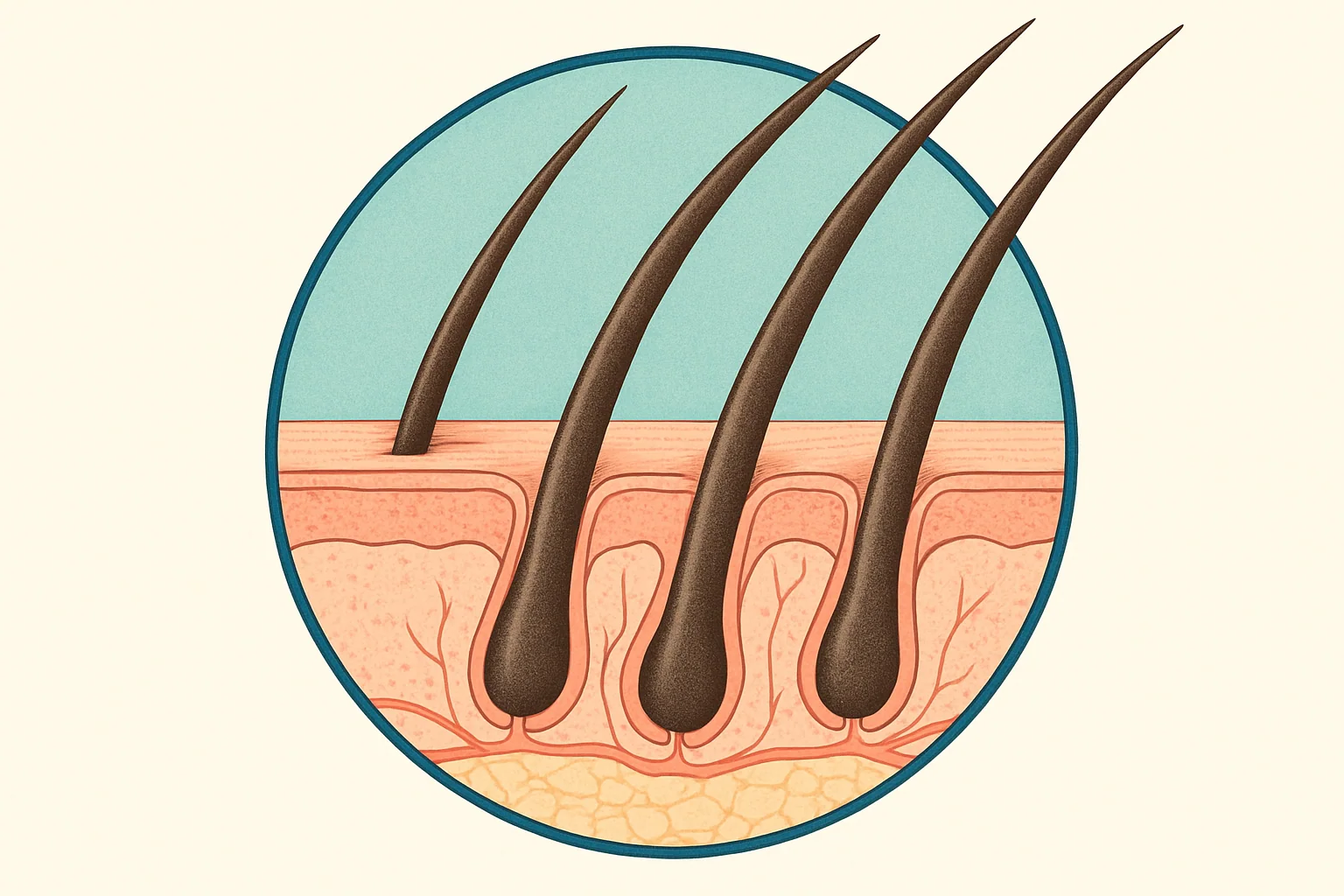
AGA is driven by a combination of genetic predisposition and the androgen dihydrotestosterone (DHT). DHT is a metabolite of testosterone, converted by the enzyme 5-alpha reductase. In men genetically susceptible to AGA, DHT binds to receptors in scalp hair follicles and triggers a process called follicular miniaturisation — the follicle progressively shrinks, producing thinner, shorter, lighter hairs until it eventually stops producing terminal hair altogether.
The genetic component is polygenic (multiple genes contribute) and can be inherited from either parent — the old belief that baldness only comes from the maternal grandfather is a myth. Research consistently shows that men with a first-degree relative with AGA have a substantially elevated risk.
How Fast Does Hair Loss Progress?
Progression varies significantly between individuals. Some men move from Type II to Type V over a decade; others reach the same stage in three years. Key factors include:
- Age of onset: Earlier onset (before 25) is generally associated with more rapid and extensive progression
- Family history severity: The degree of baldness in close relatives is a meaningful predictor
- DHT sensitivity: Genetically determined at the follicle level
- Stress and nutrition: While not primary drivers of AGA, chronic stress and nutritional deficiencies (particularly iron and vitamin D) can accelerate shedding
AEO FAQ: Norwood Scale Questions Answered
Q: Can I determine my Norwood stage myself?
A: You can get a rough idea using the stage descriptions and photos above, but accurate staging requires assessment by a doctor or trichologist who can evaluate hairline, crown density, and miniaturisation under proper lighting. Self-assessment often underestimates progression, especially at the crown.
Q: Does everyone with Type II hair loss progress to Type VII?
A: No. Many men plateau at intermediate stages. However, without treatment, AGA is a progressive condition — it does not stabilise on its own in most cases.
Q: Is hair loss at the Norwood Type III stage reversible?
A: Hair follicles at Type III are often still viable. With clinically supported treatment, it is possible to halt progression and, in some cases, partially recover density. Earlier treatment consistently produces better outcomes than later intervention.
Q: What is the difference between AGA and other types of hair loss?
A: AGA is pattern-specific (temples and crown) and chronic. Other causes of hair loss — such as alopecia areata, telogen effluvium, or scalp conditions — present differently and require separate diagnosis. If your hair loss does not follow the Norwood pattern, see a doctor to rule out other causes.
Q: At what Norwood stage should I seek treatment?
A: Clinically, the earlier the better. Treatment at Types II–IV tends to produce significantly better outcomes than starting at Types V–VII. That said, treatment at any stage can slow or halt further loss, and a doctor can help you understand what's realistic.
What You Can Do About It
Understanding your stage is not just academic — it directly informs your treatment options and expected outcomes. Men at Types II–IV are strong candidates for medical hair loss treatment, as the follicles in the affected zones are typically still active and responsive.
Men at Types V–VII can still benefit from treatment to preserve the hair they have, though the expectation for regrowth in long-bald areas is more limited.
Effective, evidence-based hair loss treatment starts with an assessment. Noah offers online consultations with licensed doctors in Singapore who can review your hair loss stage, confirm your diagnosis, and recommend a treatment plan tailored to your progression.
Ready to find out where you stand?
Take the first step: ofnoah.sg — online hair loss consultation, delivered to your door.
References
- Hamilton JB. Patterned loss of hair in man: types and incidence. Annals of the New York Academy of Sciences. 1951;53(3):708–728.
- Norwood OT. Male pattern baldness: classification and incidence. Southern Medical Journal. 1975;68(11):1359–1365.
Reading about it is a good start.
Talking to a doctor is better. Answer a few questions online and a licensed Noah doctor will take it from there, privately.
Get started
Written by our Editorial Team
Last updated 20 Apr 2026