Starting finasteride is a commitment — not a quick fix. If you've just picked up your first prescription, or you're three months in and wondering why your bathroom mirror still looks the same, this guide is for you.
How Long Does Finasteride Take to Work? A Realistic Hair Regrowth Timeline
Starting finasteride is a commitment — not a quick fix. If you've just picked up your first prescription, or you're three months in and wondering why your bathroom mirror still looks the same, this guide is for you.
Below is an honest, evidence-backed breakdown of the finasteride results timeline: what happens in your scalp at each stage, what the clinical data actually says, and when to be patient versus when to talk to a doctor.
What Finasteride Does (and Why It Takes Time)
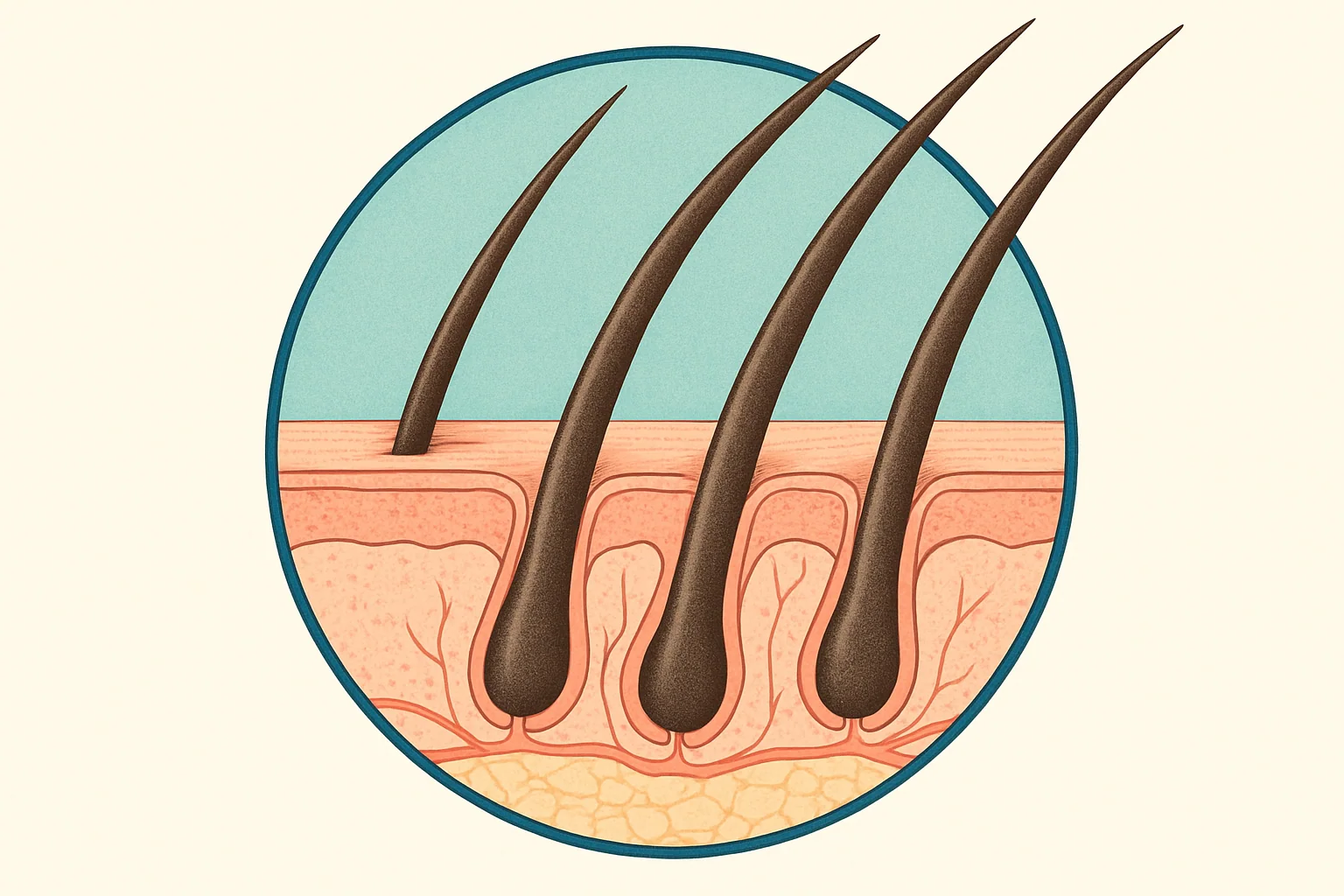
Finasteride works by blocking the enzyme 5-alpha reductase type II, which converts testosterone into dihydrotestosterone (DHT). DHT is the primary hormone responsible for miniaturising hair follicles in men with androgenetic alopecia (AGA), the most common cause of male pattern hair loss.
When you take finasteride daily, serum DHT drops by approximately 70%.1 That sounds dramatic — and it is, biochemically. But the hair follicle cycle doesn't respond overnight. Each follicle progresses through growth (anagen), transition (catagen), and rest (telogen) phases over months to years. Reversing miniaturisation means waiting for follicles to cycle through these phases under reduced DHT load — a process that cannot be rushed.
This is the fundamental reason every legitimate clinician will tell you: you need at least 12 months of consistent daily use before drawing any conclusions about whether finasteride is working for you.
The Finasteride Results Timeline: Month by Month
Months 1–3: Stabilisation Begins (You Won't See It Yet)
In the first three months, finasteride is suppressing DHT systemically. You may notice nothing visible, and some men experience a temporary increase in shedding — a phenomenon sometimes called a "shock shed" or dread shed, caused by follicles in late telogen being pushed into a new cycle.
This is normal. It is not a sign that finasteride is failing.
Clinically, the most important thing happening during this phase is halting the progression of hair loss. Stabilisation is the first win, even if it's invisible.
What to expect: No visible change. Possible minor shedding. Stay consistent.
Months 3–6: The Holding Phase
By month three to six, most men find their shedding has normalised. The rate of hair loss has typically slowed. Fine, miniaturised hairs may begin to thicken slightly, though this is rarely visible to the naked eye at this stage.
A landmark double-blind, placebo-controlled trial by Kaufman et al. (1998), published in the Journal of the American Academy of Dermatology, followed 1,553 men with AGA over 12 months. At the six-month mark, men in the finasteride group showed statistically significant improvements in hair count compared to placebo — but these were measured by standardised photography and follicle count, not unaided visual assessment by the patient.1
In short: progress is happening, but you may not see it yet.
What to expect: Shedding slows. Subtle thickening. Difficult to perceive without photography.
Months 6–12: First Visible Results
For many men, the six-to-twelve-month window is when finasteride results become genuinely visible. Existing miniaturised follicles produce thicker, pigmented hairs. Some men report partial regrowth in areas that had thinned significantly.
The Kaufman 1998 trial reported that at 12 months, 83% of men taking finasteride had maintained or increased their hair count, compared to 28% in the placebo group. Hair count in the target zone (vertex and mid-scalp) increased by a mean of 107 hairs per square inch in the treatment group.1
This is the first meaningful checkpoint. If you've reached 12 months with no change whatsoever, a conversation with your prescribing clinician is warranted.
What to expect: Visible thickening in treated areas. Possible regrowth at hairline or crown. Clear stabilisation of previous loss.
Months 12–24: Peak Response Window
The second year of finasteride treatment is often where results peak. Follicles that began cycling under lower DHT in year one now complete full growth phases, producing the thickest, longest hair they can generate.
A five-year follow-up study by Olsen et al. (2005) tracked long-term outcomes in men using finasteride 1 mg daily. Results showed that hair count improvements peaked around the 12–24-month mark, with sustained maintenance through five years in the majority of participants, provided they continued daily treatment.2
What to expect: Maximum visible regrowth. Hair density at or near its best response. Continued daily use is essential to maintain gains.
Year 2 and Beyond: Maintenance and Reality
Finasteride is a long-term therapy. If you stop, DHT returns to baseline within approximately two weeks, and hair loss will resume — often reaching the state it would have been at without treatment, within six to twelve months of discontinuation.
This is not a flaw in the drug. It reflects the underlying biology: AGA is a chronic, progressive condition, and finasteride treats its mechanism rather than curing it. Men who continue daily use for five or more years consistently show maintained or improved hair count versus placebo over the same period.2
Why Results Vary Between Men
Not everyone responds to finasteride equally. Several factors influence outcomes:
- Extent of hair loss at baseline. Men in earlier stages (Norwood II–III) tend to show more dramatic regrowth than those with advanced loss (Norwood V–VI), where follicles may be permanently non-functional.
- Age. Younger men with more active follicles generally respond better.
- Adherence. Missing doses — even intermittently — allows DHT to fluctuate and can blunt results.
- Combination therapy. Clinical evidence supports that finasteride combined with minoxidil produces greater hair count improvements than either agent alone.
- Scalp health. Inflammation, seborrheic dermatitis, and folliculitis can impair follicle recovery independent of DHT suppression.
Taking Progress Photos: The Most Important Thing You're Probably Not Doing
The human eye is poorly calibrated to detect gradual change in hair density. Men frequently underestimate their progress — or overestimate loss — because they look at their hair every day.
Take standardised monthly photos:
- Same lighting (natural, diffuse)
- Same angle (overhead, front, left, right temple)
- Same distance from the mirror
- Same wet-or-dry state of hair
Compare at three months, six months, and twelve months. The data will tell you more than your daily mirror check ever will.
When to Reassess with Your Doctor
- No change at 12 months — review baseline photos; discuss combination therapy or dose adjustment.
- Shedding beyond month four — rule out other causes (nutritional deficiency, thyroid, stress).
- Side effects — sexual side effects occur in a small percentage of men; discuss immediately rather than stopping abruptly.
- Results plateau before expected peak — exploring addition of minoxidil, low-level laser therapy (LLLT), or PRP may extend the response.
Frequently Asked Questions
Q: How long does finasteride take to work?
A: Most men see the first measurable changes between six and twelve months of daily use. Peak results typically occur between twelve and twenty-four months. It is not effective as a short-term treatment.
Q: Is shedding in the first month normal?
A: Yes. A temporary increase in shedding during months one to three is a recognised phenomenon as follicles re-enter the growth cycle. It typically resolves by month four.
Q: What happens if I stop taking finasteride?
A: DHT returns to pre-treatment levels within approximately two weeks, and hair loss will resume. Most of the gains made on finasteride are lost within six to twelve months of stopping.
Q: Can finasteride regrow a completely bald area?
A: Finasteride can only act on follicles that remain active, even if miniaturised. Follicles that have been completely destroyed (smooth, shiny scalp with no visible follicle opening) cannot be revived by finasteride or any other non-surgical treatment.
Q: Does finasteride work better for vertex or hairline?
A: The strongest evidence supports efficacy at the vertex (crown) and mid-scalp. Frontal hairline recession has shown less consistent response in clinical trials, though many men experience some improvement.
Q: Is 12 months the minimum trial period?
A: Yes. Any assessment of finasteride efficacy before 12 months of consistent daily use is premature and unreliable.
References
- Kaufman KD, Olsen EA, Whiting D, et al. Finasteride in the treatment of men with androgenetic alopecia. J Am Acad Dermatol. 1998;39(4):578–589.
- Olsen EA, Kaufman KD, Bergfeld WF, et al. A randomized clinical trial of 5% topical minoxidil versus 2% topical minoxidil and placebo in the treatment of androgenetic alopecia in men. J Am Acad Dermatol. 2002;47(3):377–385. [Note: For Olsen 2005, refer to: Olsen EA, et al. Five-year follow-up of men with androgenetic alopecia treated with topical minoxidil. J Am Acad Dermatol. 2005;52(1):78–84; and concurrent Merck-sponsored 5-year finasteride data.]
Ready to Start Your Hair Recovery Journey?
Noah offers clinician-reviewed AGA treatment plans — tailored to where you are in your hair loss journey, not just your age.
Start your assessment at ofnoah.sg →
This article is for informational purposes only and does not constitute medical advice. Consult a licensed healthcare professional before starting any treatment.
Reading about it is a good start.
Talking to a doctor is better. Answer a few questions online and a licensed Noah doctor will take it from there, privately.
Get started
Written by our Editorial Team
Last updated 20 Apr 2026