A derma roller (also called a microneedling device) is a handheld roller fitted with a drum of fine needles — typically 0.25 mm to 1.5 mm in length. When rolled across the scalp, those needles create controlled micro-injuries in the uppermost layers of skin.
What Is a Derma Roller, and What Does It Do?
A derma roller (also called a microneedling device) is a handheld roller fitted with a drum of fine needles — typically 0.25 mm to 1.5 mm in length. When rolled across the scalp, those needles create controlled micro-injuries in the uppermost layers of skin.
That might sound counterproductive. Why would you wound a scalp you're trying to help?
The answer lies in the body's repair response.
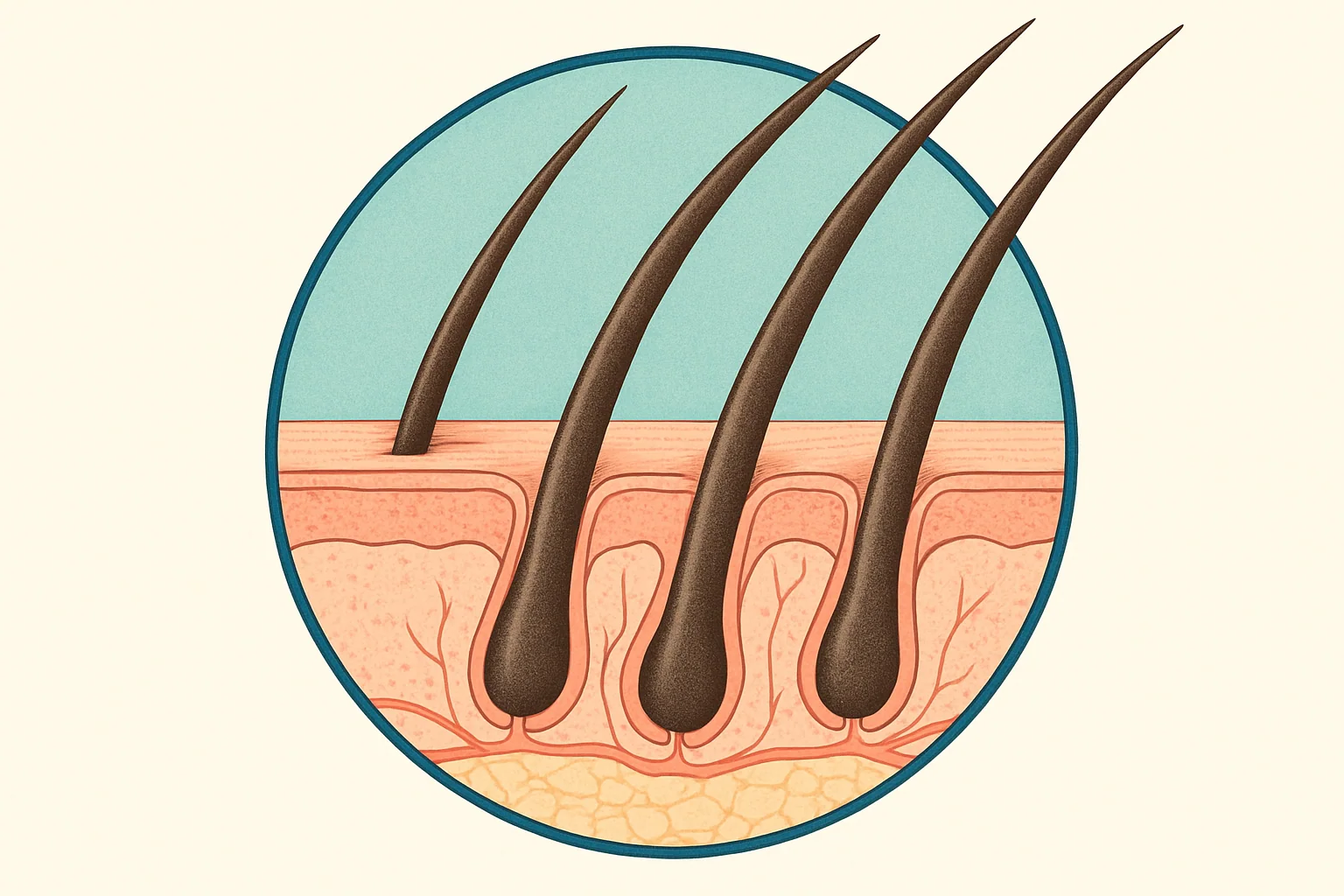
When tissue is micro-injured, the body immediately mobilises a cascade of growth factors and signalling proteins — including platelet-derived growth factor (PDGF), vascular endothelial growth factor (VEGF), and Wnt/β-catenin pathway activators. These molecules play a direct role in the hair follicle cycle: they help push follicles out of the resting (telogen) phase and back into active growth (anagen). They also stimulate collagen production around the follicle, improving the vascular environment that hair relies on for nutrients.
In short: controlled micro-trauma tells the scalp that repair is needed, and the repair process happens to overlap heavily with the biological machinery of hair growth.
The Clinical Evidence for Microneedling and Hair Loss
This isn't just theory. The landmark study in this space was published in 2013 by Dhurat et al. in the International Journal of Trichology. In this randomised, evaluator-blinded pilot study, 100 men with androgenetic alopecia (male pattern hair loss, or AGA) were divided into two groups:
- Group A: Minoxidil 5% twice daily + weekly microneedling sessions (1.5 mm roller)
- Group B: Minoxidil 5% twice daily alone
After 12 weeks, the microneedling group showed a mean hair count increase of 91.4 new hairs per cm², compared to just 22.2 new hairs per cm² in the minoxidil-only group. That's a roughly fourfold difference — a result that caught significant attention in the dermatology community.
Importantly, patient satisfaction scores also favoured the microneedling group, with 82% rating their response as "excellent" versus 4.5% in the control group.
Citation: Dhurat R, Sukesh M, Avhad G, Dandale A, Pal A, Pund P. A Randomized Evaluator Blinded Study of Effect of Microneedling in Androgenetic Alopecia: A Pilot Study. Int J Trichology. 2013;5(1):6–11.
Subsequent research and clinical case series have broadly supported these findings, pointing to microneedling as a useful adjunct — particularly when used alongside evidence-based pharmacological treatments like minoxidil or finasteride.
Who Is Dermarolling Most Likely to Help?
The current evidence is strongest for androgenetic alopecia (AGA) — the type of hair loss driven by dihydrotestosterone (DHT) sensitivity in the follicles. This is the most common form of hair loss in men (and a significant cause in women), characterised by a progressive miniaturisation of hair follicles along the hairline and crown.
Microneedling is also being studied in the context of:
- Alopecia areata (patchy, autoimmune-driven hair loss)
- Female pattern hair loss (FPHL)
- Enhancing topical absorption — microneedling dramatically increases the penetration of topical agents like minoxidil, which may partly explain the synergistic results seen in the Dhurat study
Microneedling is not a replacement for addressing the root cause of hair loss. For AGA, DHT is the primary driver. No amount of scalp stimulation will fully compensate for ongoing follicle miniaturisation if that hormonal mechanism is left unchecked. The evidence supports using dermarolling alongside DHT-targeted treatments, not instead of them.
Needle Length: Which Size Should You Use?
This matters more than most product descriptions let on.
| Needle Length | Use Case | Notes |
|---|---|---|
| 0.25 mm | Daily at-home use, product absorption | Too short for meaningful wound response |
| 0.5 mm | At-home use 2–3×/week | Activates mild repair response |
| 1.0 mm | Weekly at-home or clinic use | Meaningful growth factor activation |
| 1.5 mm | Clinical use (supervised) | Used in Dhurat study; most robust evidence |
Most dermatologists recommend 0.5 mm to 1.0 mm for safe, unsupervised home use. The 1.5 mm length used in the Dhurat study is effective but requires proper technique to avoid irritation or post-treatment infection. Many clinics offer microneedling at this depth using motorised devices (dermapens) with more precise depth control than rollers.
How to Use a Derma Roller on the Scalp Safely
If you're using a derma roller at home, these steps reduce the risk of irritation or infection:
- Disinfect the roller before each use with 70% isopropyl alcohol. Allow to dry.
- Divide the scalp into sections — crown, temples, hairline — and work methodically.
- Apply light pressure and roll in 4 directions: vertical, horizontal, and both diagonals (8–10 passes per section).
- Avoid broken skin, active scalp conditions (psoriasis, seborrhoeic dermatitis flares), or any open wounds.
- Apply your topical treatment (e.g., minoxidil) immediately after. Absorption increases dramatically post-needling.
- Clean the roller again post-use and store in its case.
- Replace your roller every 3–6 months, or sooner if needles appear bent.
Frequency: Most protocols for 1.0 mm suggest once weekly. For 0.5 mm, 2–3 times per week is reasonable. Give the scalp 24–48 hours to recover between sessions.
What Dermarolling Won't Do
It's worth being honest about limitations.
Microneedling cannot reverse scarring alopecia — if the follicle has been permanently destroyed by inflammation (as in lichen planopilaris or frontal fibrosing alopecia), no amount of needling will regenerate it. It also won't replace the need for medical treatment in progressive AGA. If your hair loss is advancing, dermarolling is a tool in a protocol, not a standalone solution.
Results also take time. The Dhurat study measured outcomes at 12 weeks. Most clinicians recommend committing to at least 3–6 months before evaluating whether the approach is working for you.
How Dermarolling Fits Into a Complete Hair Loss Protocol
The most effective hair loss protocols combine multiple mechanisms:
- DHT blockade — finasteride (oral) or dutasteride reduce the hormone that miniaturises follicles
- Follicle stimulation — minoxidil increases blood flow and prolongs anagen
- Scalp environment support — microneedling, proper nutrition, scalp health
- Monitoring — trichoscopy or standardised hair counts to track progress
Dermarolling addresses the third pillar. When added to an established minoxidil routine, the evidence suggests it can meaningfully improve outcomes — potentially by enhancing both topical absorption and the underlying follicular biology.
Frequently Asked Questions
Q: Can I use a derma roller every day? A: For needle lengths of 0.5 mm or above, daily use is not recommended. The scalp needs 24–48 hours to recover. Over-rolling can cause irritation and defeat the purpose. 0.25 mm rollers can be used more frequently but have limited evidence for hair growth.
Q: Does dermarolling hurt? A: At 0.5–1.0 mm, most people experience mild tingling or a scratching sensation. At 1.5 mm, some discomfort is normal. If you experience significant pain, you're likely applying too much pressure.
Q: How long before I see results from dermarolling? A: The Dhurat 2013 study showed significant results at 12 weeks. Realistically, 3–6 months of consistent use is the minimum timeframe to assess efficacy.
Q: Is microneedling at a clinic better than at-home dermarolling? A: Clinic devices (dermapens) offer more precise depth control, better hygiene protocols, and access to higher needle depths. For AGA, clinical sessions at 1.5 mm likely outperform at-home 0.5 mm rollers — but at-home use is a practical complement to a medical protocol.
Q: Can women use a derma roller for hair growth? A: Yes. While most clinical data focuses on male AGA, female pattern hair loss shares similar biological mechanisms. Dermarolling is used in FPHL protocols, often combined with topical minoxidil.
Q: Should I use dermarolling instead of finasteride? A: No. Dermarolling stimulates the scalp environment but does not address DHT — the primary driver of AGA. It's best used alongside, not instead of, pharmacological treatment.
The Bottom Line
Dermarolling is not hype. The evidence — anchored by the Dhurat 2013 randomised study — demonstrates that microneedling at 1.5 mm, used weekly alongside minoxidil, can produce significantly better hair regrowth outcomes than minoxidil alone. The mechanism is real: micro-injury triggers growth factor release that activates the follicle cycle.
What it isn't: a replacement for addressing the root cause of hair loss. For AGA, that means DHT. Dermarolling works best as part of a complete protocol — one that's been thought through, not cobbled together from forum posts.
If you're dealing with hair loss and want to understand your options clearly, Noah offers clinician-backed hair loss treatment plans built around your specific pattern and history.
Reading about it is a good start.
Talking to a doctor is better. Answer a few questions online and a licensed Noah doctor will take it from there, privately.
Get started
Written by our Editorial Team
Last updated 20 Apr 2026