If you've typed "am I going bald?" into Google at 2am, you're not alone. But figuring out where you are on the hair loss spectrum — and more importantly, what to do about it — requires more than a worried glance in the mirror.
Hair Loss Stages: The Norwood Scale Explained & When to Start Treatment
If you've typed "am I going bald?" into Google at 2am, you're not alone. But figuring out where you are on the hair loss spectrum — and more importantly, what to do about it — requires more than a worried glance in the mirror.
The Norwood Scale is the universal tool doctors use to classify male pattern hair loss. Understanding it isn't just academic. The stage you're at right now has a direct bearing on which treatments will work, how quickly you need to act, and what realistic outcomes look like.
This guide explains the Norwood Scale from Type I through Type VII, tells you what each stage means clinically, and answers the question most men are really asking: when is the right time to start treatment?
What Is Male Pattern Hair Loss (Androgenetic Alopecia)?
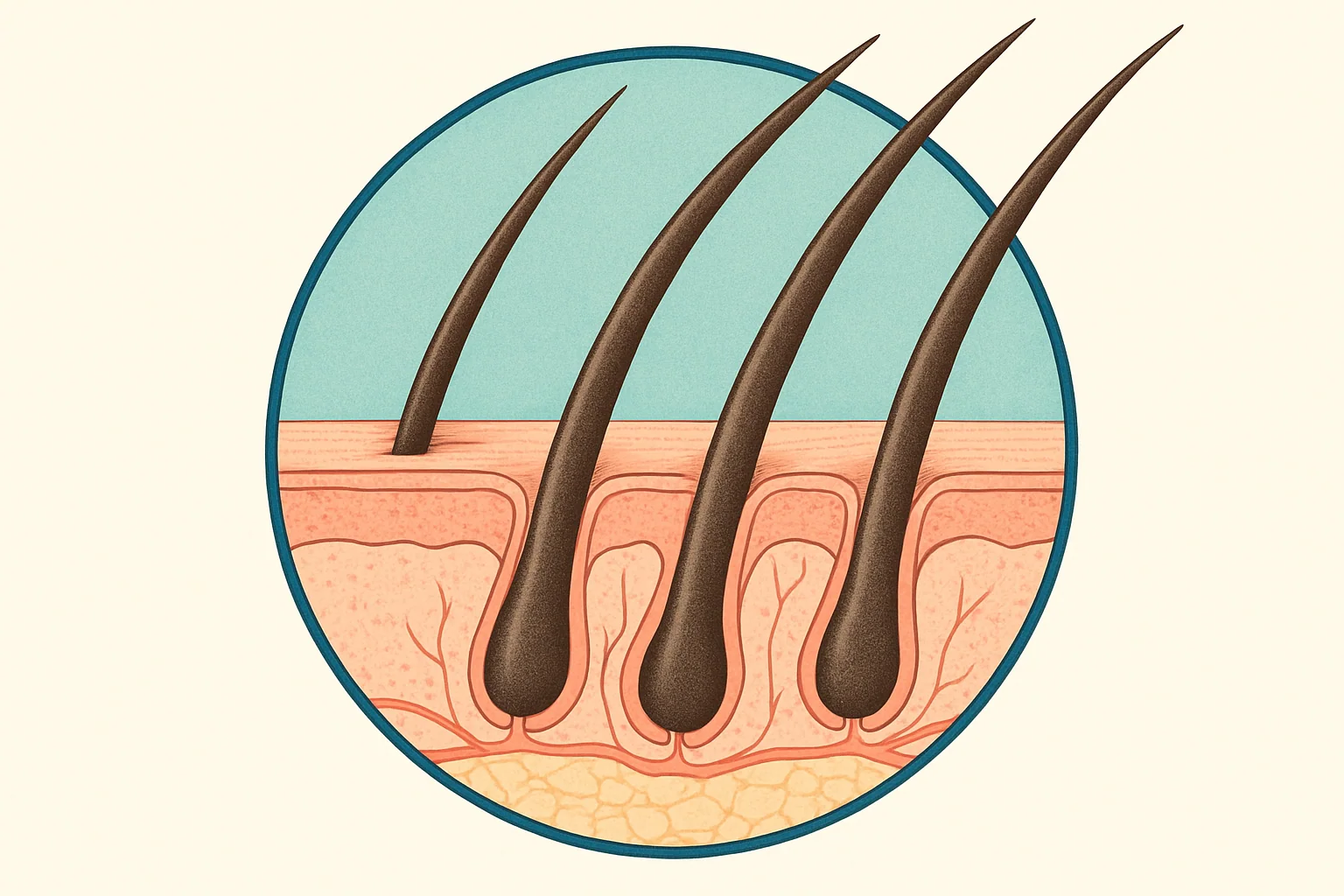
Male pattern hair loss — known clinically as androgenetic alopecia, or AGA — affects an estimated 50% of men by age 50 and up to 80% by age 70.¹ It's driven by a well-understood hormonal mechanism: dihydrotestosterone (DHT), a metabolite of testosterone, binds to receptors in genetically susceptible hair follicles and progressively miniaturises them. Over time, terminal hairs (thick, pigmented) are replaced by vellus hairs (short, thin, colourless), and eventually the follicle stops producing hair at all.
The critical word is progressive. AGA does not plateau on its own. Without intervention, it continues — typically across decades, following a predictable pattern that the Norwood Scale maps.
The Norwood Scale: All 7 Stages Explained
The Hamilton-Norwood Scale was first published by James Hamilton in 1951 and significantly refined by O'Tar Norwood in 1975.² It remains the dominant classification system for male androgenetic alopecia worldwide.
The scale distinguishes between two main patterns of recession — frontal/temporal (hairline) and vertex (crown) — and identifies seven primary types, several of which have "A" variants (where recession progresses along the front rather than leaving an island of hair).
Type I — No Significant Recession
This is the baseline. A mature hairline may have slightly receded from the juvenile hairline (which typically sits at or above the first forehead crease), but there is no significant thinning or recession. Most men are still at Type I in their late teens and early 20s.
Clinical note: A small number of men with AGA genetics will begin losing density here, visible under close inspection or with a dermatoscope. The follicles are miniaturising but the loss isn't cosmetically apparent yet.
Type II — Early Temporal Recession
The hairline begins to recede symmetrically at the temples, forming a gentle M-shape. There may also be minor thinning at the vertex. Cosmetically, this is often dismissed as "just getting older" — but it marks the onset of clinically significant AGA.
When men typically notice: Mid-20s to early 30s, often when someone else points it out.
Type III — Visible Hairline Recession
The temples have receded significantly, creating a more pronounced M, U, or V shape. The areas of recession may be bare or contain only sparse, fine hairs. Type III is the earliest stage at which most dermatologists consider treatment clearly warranted.
Type III Vertex is a variant where crown thinning begins simultaneously, often before the hairline recession becomes dramatic. This is a clinically important subtype — vertex loss at this stage signals a more aggressive progression pattern.
Type IV — Significant Frontal and Crown Loss
Frontal recession has progressed deeper, and vertex thinning is now distinctly visible. Critically, there is still a bridge of hair connecting the two areas. The overall scalp coverage is noticeably reduced.
Treatment urgency escalates here. At Type IV, a meaningful number of follicles have been permanently lost. Treatment can stabilise what remains and may partially recover recently miniaturised follicles, but the window for full density restoration is narrowing.
Type V — Bridge Begins to Break Down
The band of hair separating the frontal and vertex regions is now thin and narrowing. The two areas of loss are converging. Profile photographs begin to show a horseshoe-shaped pattern forming.
Hair transplant planning begins here for many patients — the donor zone (typically occipital and temporal) remains viable, but the surface area requiring coverage is increasing.
Type VI — Frontal and Vertex Loss Merge
The bridge has gone. Frontal recession and vertex thinning have merged into a single, continuous area of loss. Only the classic horseshoe fringe of hair remains around the sides and back.
Medical treatments (finasteride, minoxidil) offer limited regrowth benefit at this stage — their primary value is preventing further loss in remaining follicles. Hair transplant surgery becomes the main restoration option.
Type VII — Advanced Loss
The most extensive stage. The remaining horseshoe fringe is sparse, low, and confined to the sides and nape. The donor zone may be compromised, which limits transplant candidacy.
For Type VII patients, honest goal-setting is essential. The focus shifts from reversal to management: scalp micropigmentation, strategic styling, or acceptance.
The "A" Pattern Variants
Types III, IV, and V each have "A" (anterior) variants, where recession advances across the entire frontal hairline rather than preserving a central forelock. These patterns tend to produce a higher, wider zone of visible loss earlier, and are associated with faster aesthetic impact.
When Should You Start Treatment?
This is the question most men actually want answered. The evidence-based answer: earlier than you think, and almost certainly before you feel ready.
The Follicle Is Either Alive or It Isn't
Hair follicles exist in one of three states: actively producing hair, miniaturised (producing vellus hair), or permanently destroyed. Current FDA-approved treatments — finasteride and minoxidil — work by interrupting DHT activity and extending the anagen (growth) phase respectively. They can rescue miniaturised follicles. They cannot restore permanently destroyed ones.
The problem: by the time hair loss is visually apparent in a mirror, up to 50% of follicular density in that area may already be lost.³
This is why dermatologists consistently recommend starting treatment at Type II or early Type III — not waiting until you're "really" losing hair. The follicles that can be saved are the ones that are currently miniaturising. Waiting until they're gone removes the option.
What the Evidence Says About Treatment Timing
A five-year randomised controlled trial of finasteride 1 mg (Propecia) vs. placebo — the pivotal Phase III trial that led to FDA approval — showed that 48% of men taking finasteride maintained or increased hair count over five years, versus progressive loss in 100% of placebo patients.⁴ A separate long-term observational study by Rossi et al. (2011) demonstrated that men who started finasteride at earlier Norwood stages had meaningfully better outcomes than those who started later.⁵
For minoxidil, a Cochrane systematic review found 5% topical minoxidil superior to 2% and to placebo, with greatest benefit in men with active miniaturisation rather than established baldness.⁶
The data converges on a consistent conclusion: earlier intervention, better outcomes.
Type II–III: High Value Window
This is the optimal window. Medical treatments are most effective here:
- Finasteride can stabilise loss and produce regrowth in a meaningful proportion of patients
- Minoxidil (topical or oral) augments the response
- No surgical intervention required
- Donor hair is fully available for future planning
Type III–IV: Still Worthwhile, More Work
Medical treatments still offer real benefit. Partial regrowth is achievable. Combination therapy (finasteride + minoxidil) is typically recommended. Some patients at this stage also begin exploring hair transplant consultations — not necessarily to proceed now, but to understand options and preserve planning flexibility.
Type V–VI: Maintenance + Surgical Planning
Medical treatment is now focused on halting progression rather than achieving meaningful regrowth. Hair transplant surgery — follicular unit extraction (FUE) or follicular unit transplantation (FUT) — becomes the primary pathway to density restoration. Medical treatment is still recommended post-transplant to protect native hair.
Type VII: Goal-Setting Conversation
The honest advice here is to manage expectations. Some patients choose FUE using the limited remaining donor hair for a hairline frame; others choose scalp micropigmentation; others choose not to pursue intervention at all. All are valid.
Other Signs Treatment Is Warranted — Beyond Scale Stage
Stage alone doesn't tell the whole story. Treat these as additional signals to act now:
- Rapid progression: Moving a full Norwood stage in under 12 months indicates aggressive AGA genetics — early intervention is especially important
- Positive family history of early loss: If a father or maternal grandfather was significantly bald by 30, your trajectory may be accelerated
- Diffuse thinning without recession: Some men experience AGA as global density loss rather than a receding hairline — this can be missed by the Norwood scale and requires dermatoscopic assessment
- Excessive shedding (telogen effluvium): May co-occur with AGA and can be distinguished through clinical evaluation
Frequently Asked Questions
Q: Can I reverse hair loss once it starts? Full reversal of established baldness is not currently possible with medical treatment. However, regrowth of recently miniaturised follicles is achievable in the early-to-mid stages with finasteride and/or minoxidil. Hair transplant surgery can restore cosmetic density at more advanced stages.
Q: Is the Norwood Scale accurate for all men? The Norwood Scale was developed primarily from studies of men of European descent. It remains widely applicable but may not perfectly capture all patterns — particularly diffuse thinning presentations more common in some East and Southeast Asian men. A dermatologist's clinical assessment provides greater accuracy than self-classification.
Q: How do I figure out my Norwood stage? The most reliable method is evaluation by a dermatologist or trichologist, ideally using dermatoscopy (a magnified view of the scalp) to assess follicle miniaturisation. Self-assessment using reference images is a reasonable starting point, but it's common to underestimate — particularly in the vertex, which is hard to photograph accurately.
Q: What's the first step if I think I'm losing hair? Get a clinical assessment while you still have options. The biggest mistake most men make is waiting until they're "really" bald before seeking help — by which point the most impactful treatment window has passed.
Q: Does stress cause the same kind of hair loss? Stress-related hair loss (telogen effluvium) is a separate condition that typically presents as diffuse shedding 2–3 months after a stressor, and usually reverses once the stressor resolves. AGA is hormonal and genetic, and follows the Norwood pattern. The two can coexist, which sometimes causes confusion.
References
- Kanti V, et al. "Androgenetic alopecia." *Journal of the German Society of Dermatology.* 2018;16(10):1188–1198.
- Norwood OT. "Male pattern baldness: Classification and incidence." *Southern Medical Journal.* 1975;68(11):1359–1365.
- Rushton DH, et al. "Causes of hair loss and the developments in hair rejuvenation." *International Journal of Cosmetic Science.* 2002;24(1):17–23.
- Kaufman KD, et al. "Finasteride in the treatment of men with androgenetic alopecia." *Journal of the American Academy of Dermatology.* 1998;39(4):578–589.
- Rossi A, et al. "Finasteride, 1 mg daily administration on male androgenetic alopecia in different age groups: 10-year follow-up." *Dermatologic Therapy.* 2011;24(4):455–461.
- van Zuuren EJ, et al. "Interventions for female pattern hair loss." *Cochrane Database of Systematic Reviews.* 2016;5:CD007628. *(Includes male minoxidil evidence summary.)*
Ready to Find Out Where You Stand?
If you recognise your hairline in Type II or Type III above, the most important thing you can do right now is get a proper assessment — not another Google search.
Noah offers online consultations with licensed doctors who specialise in androgenetic alopecia. If treatment is appropriate, a personalised plan can be delivered to your door.
Start your online hair assessment → ofnoah.sg
Available islandwide. Discreet packaging. No awkward pharmacy queues.
Reading about it is a good start.
Talking to a doctor is better. Answer a few questions online and a licensed Noah doctor will take it from there, privately.
Get started
Written by our Editorial Team
Last updated 20 Apr 2026
Articles featured on Noah are for informational purposes only and should not be constituted as medical advice, diagnosis or treatment. If you have any medical questions or concerns, please talk to your healthcare provider.