If you've been researching hair loss treatments, you've likely come across two names: finasteride and dutasteride. Both are prescription medications that work on the same hormonal pathway — and both have clinical evidence behind them. But they are not the same drug, and the differences matter.
Dutasteride vs Finasteride for Hair Loss: Which is Stronger?
If you've been researching hair loss treatments, you've likely come across two names: finasteride and dutasteride. Both are prescription medications that work on the same hormonal pathway — and both have clinical evidence behind them. But they are not the same drug, and the differences matter.
This article breaks down how each works, what the clinical data actually shows, and how to think about which might be right for you. Spoiler: the answer depends more on your individual situation than a simple "stronger is always better" logic.
The Root Cause: DHT and Androgenetic Alopecia
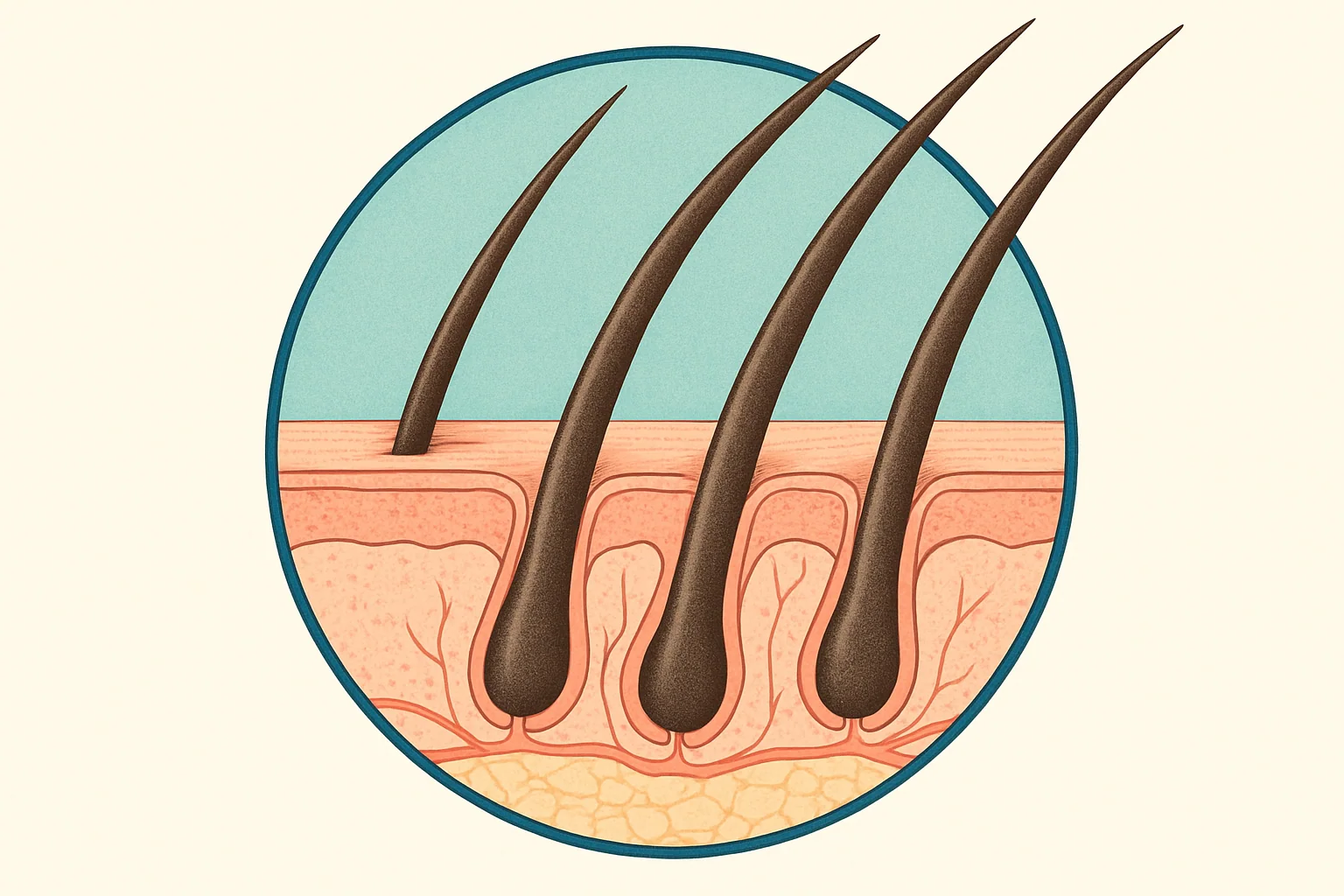
Androgenetic alopecia (AGA), commonly called male pattern hair loss, affects roughly 50% of men by age 50. The primary driver isn't testosterone itself — it's dihydrotestosterone (DHT), a more potent androgen converted from testosterone by an enzyme called 5-alpha reductase (5AR).
DHT binds to androgen receptors in hair follicles, progressively miniaturising them over years and decades. Once a follicle miniaturises past a threshold, the hair it produces becomes finer, shorter, and eventually stops growing altogether.
Both finasteride and dutasteride work by inhibiting 5-alpha reductase — blocking the conversion of testosterone to DHT. But they differ in which variants of the enzyme they target, and by how much.
How They Differ: 5AR Type I vs Type II
There are two main isoforms of 5-alpha reductase relevant to hair loss:
- Type I is found primarily in the scalp, skin, and liver
- Type II is the predominant form in hair follicles and the prostate
Finasteride selectively inhibits Type II 5AR. At the standard 1 mg/day dose for hair loss, it reduces circulating DHT by approximately 60–70%.
Dutasteride inhibits both Type I and Type II 5AR. At the standard 0.5 mg/day dose, it reduces circulating DHT by approximately 90–95% — a substantially deeper suppression.
This dual-inhibition mechanism is why dutasteride is often described as the "stronger" of the two. But greater DHT suppression doesn't automatically mean better hair outcomes for every patient, and it comes with a different risk-benefit profile.
What the Clinical Evidence Shows
Finasteride
Finasteride at 1 mg/day for AGA was approved by the FDA in 1997, backed by pivotal trials showing statistically significant hair count improvements versus placebo at 12 and 24 months. Long-term data from five-year studies confirmed sustained benefit with continued use: men who discontinued treatment lost their gains within 12 months.
The Olsen et al. study (JAAD, 2002) demonstrated that finasteride 1 mg/day significantly increased hair counts at both the vertex and frontal scalp in men with mild to moderate AGA over 5 years.
Dutasteride
Dutasteride's strongest comparative evidence comes from the Gubelin Harcha et al. randomised controlled trial published in the Journal of the American Academy of Dermatology (JAAD, 2014). This multicentre, double-blind study compared dutasteride 0.02 mg, 0.1 mg, 0.5 mg, and placebo against finasteride 1 mg over 24 weeks in men with AGA.
Key findings: - Dutasteride 0.5 mg produced significantly greater improvements in target area hair count compared to finasteride 1 mg at 24 weeks - The dutasteride 0.5 mg group showed a mean increase of ~12.2 hairs per cm² vs ~7.6 for finasteride — roughly 60% greater hair count improvement - Patient self-assessment and investigator global assessment also favoured dutasteride 0.5 mg - Adverse event rates were broadly similar between dutasteride and finasteride groups in the short term
A separate randomised trial by Eun et al. (JAAD, 2010) confirmed dutasteride 0.5 mg/day produced significantly greater improvements than placebo over 24 weeks, with a favourable safety profile.
Jung JY et al. (International Journal of Dermatology, 2014) similarly found superior hair count and thickness outcomes for dutasteride vs finasteride, with particular advantage noted in frontal/temple recession — an area where finasteride often shows modest results.
The Honest Comparison
| Finasteride 1mg | Dutasteride 0.5mg | |
|---|---|---|
| DHT reduction | ~60–70% | ~90–95% |
| 5AR inhibition | Type II only | Type I + II |
| Clinical hair count improvement | Significant vs placebo | Significantly greater than finasteride |
| Time to noticeable effect | 3–6 months | 3–6 months |
| FDA/regulatory approval for AGA | Yes (FDA 1997) | Not FDA-approved for AGA; approved in South Korea, Japan |
| Half-life | ~6 hours (1mg) | ~5 weeks |
The long half-life of dutasteride has practical implications: if side effects occur, they may take considerably longer to resolve after stopping the medication compared to finasteride.
Side Effects: What's the Real Risk?
Both medications can cause sexual side effects in a minority of users — reduced libido, erectile dysfunction, and ejaculatory changes. The quoted incidence in clinical trials is low (around 1–4%), though real-world rates may be higher.
The key considerations:
- Finasteride's short half-life means side effects typically resolve within days to weeks of stopping
- Dutasteride's ~5-week half-life means DHT suppression (and any associated side effects) can persist for months after discontinuation
- Both medications are contraindicated in women who are or may become pregnant due to risk of feminisation of a male fetus
- Dutasteride may theoretically carry greater risk of gynecomastia due to deeper DHT suppression, though clinical trial data doesn't show dramatically different rates versus finasteride at standard doses
The question of post-finasteride syndrome (persistent side effects after discontinuation) remains debated in the medical literature. Men with concerns should discuss their history with a qualified physician before starting either medication.
Who Might Benefit from Dutasteride vs Finasteride?
There's no universal "better" — it depends on individual response, stage of hair loss, and risk tolerance.
Finasteride may be preferred when: - Starting treatment for mild to moderate AGA for the first time - You want a medication with longer regulatory track record for AGA - You prefer the option of faster side-effect resolution if needed - Cost is a significant factor (generic finasteride is widely available)
Dutasteride may be considered when: - You've had a suboptimal response to finasteride over 12+ months - Your hair loss is more advanced or progressing rapidly - Your prescribing doctor assesses that deeper DHT suppression is clinically warranted - You understand and accept the longer washout period if you need to stop
Neither drug reverses significant baldness — both work best when started earlier, before extensive follicle miniaturisation has occurred. They are most effective as preservation and partial regrowth treatments.
The Role of Combination Therapy
Many clinicians combine 5AR inhibitors with topical minoxidil for additive benefit. Minoxidil acts via a different mechanism (potassium channel opening, increased follicular blood flow) and evidence supports combining it with finasteride or dutasteride for greater total hair count improvements than either alone.
Some protocols also include topical finasteride or dutasteride formulations to reduce systemic DHT suppression while delivering the drug locally to the scalp — an approach increasingly offered through telehealth platforms.
Getting Started: The Telehealth Route
Both medications require a prescription from a licensed physician. A doctor will assess your hair loss pattern, medical history, and contraindications before recommending a treatment protocol.
In Singapore, accessing these treatments through a telehealth provider means you can complete a consultation online, have a doctor review your case, and receive a personalised treatment plan — without clinic queues or in-person appointments.
Ready to speak with a doctor about your options?
Start your hair loss consultation at ofnoah.sg →
Noah is a telehealth platform connecting Singaporean men with licensed physicians for prescription hair loss treatment. All consultations are confidential, conducted by qualified doctors, and medications are dispensed by licensed pharmacies.
References
- Gubelin Harcha W, Barboza Martínez J, Tsai TF, et al. A randomized, active- and placebo-controlled study of the efficacy and safety of different doses of dutasteride versus placebo and finasteride in the treatment of male subjects with androgenetic alopecia. J Am Acad Dermatol. 2014;70(3):489-498.e3. doi:10.1016/j.jaad.2013.10.049
- Eun HC, Kwon OS, Yeon JH, et al. Efficacy, safety, and tolerability of dutasteride 0.5 mg once daily in male patients with male pattern hair loss: a randomized, double-blind, placebo-controlled, phase III study. J Am Acad Dermatol. 2010;63(2):252-258. doi:10.1016/j.jaad.2009.09.018
- Jung JY, Yeon JH, Choi JW, et al. Effect of dutasteride 0.5 mg/d in men with androgenetic alopecia recalcitrant to finasteride. Int J Dermatol. 2014;53(11):1351-1357. doi:10.1111/ijd.12060
- Olsen EA, Hordinsky M, Whiting D, et al. The importance of dual 5α-reductase inhibition in the treatment of male pattern hair loss: results of a randomized placebo-controlled study of dutasteride versus finasteride. J Am Acad Dermatol. 2006;55(6):1014-1023.
- Olsen EA, Dunlap FE, Funicella T, et al. Long-term (5-year) multinational experience with finasteride 1 mg in the treatment of men with androgenetic alopecia. J Am Acad Dermatol. 2002;47(3):377-385.
- Kaufman KD, Olsen EA, Whiting D, et al. Finasteride in the treatment of men with androgenetic alopecia. J Am Acad Dermatol. 1998;39(4 Pt 1):578-589.
- Zito PM, Bistas KG, Syed K. Finasteride. In: StatPearls. StatPearls Publishing; 2024.
This article is for educational purposes and does not constitute medical advice. All medications described require a prescription from a licensed physician. Consult a qualified doctor before starting any hair loss treatment.
Reading about it is a good start.
Talking to a doctor is better. Answer a few questions online and a licensed Noah doctor will take it from there, privately.
Get started
Written by our Editorial Team
Last updated 20 Apr 2026