Most men in Singapore eat hawker food several times a week — it's affordable, fast, and culturally embedded. The problem isn't hawker food itself. It's that the average hawker plate is calorie-dense, carb-heavy, and lower in protein than most weight-loss diets need it to be. This guide walks through the macros of the dishes you're actually eating, where to find more protein and fewer calories without giving up the experience, and when it's worth speaking to a doctor about medical weight management.
Why hawker macros matter for weight loss
Weight loss happens when you take in fewer calories than you burn, sustained over time. That's the only mechanism — every diet, drug, and protocol works through that lever. What complicates it is that two plates with the same calorie count don't have the same effect on you. A 700-calorie plate that's mostly rice will leave you hungry by 3pm and craving more carbs. A 700-calorie plate with 35–40g of protein will keep you full for hours and protect muscle while you lose fat.
Three macro principles worth knowing if you eat hawker:
- Protein is the lever. Aim for roughly 1.6–2.2g of protein per kg of body weight per day if you're trying to lose fat while preserving muscle. For an 80kg man, that's 130–175g of protein daily — more than most hawker default plates deliver.
- Carbs aren't the enemy, but the portion is. The default hawker rice portion is large. Halving the rice on most plates removes 150–250 calories without touching the protein or vegetables.
- Hidden calories are mostly fat and sauce. Coconut milk in laksa, lard in char kway teow, deep-frying, sauces, and the oil used to wok-fry add real calories you don't see. These are usually where the same dish at two stalls can differ by 200 calories.
Typical macros of common hawker dishes
These are rough averages — actual numbers vary by stall, portion, and how generous the auntie is with oil. Use them to compare, not as gospel.
Chicken rice
A standard plate of steamed chicken rice comes in around 600–700 calories, with roughly 25–30g of protein, 70–90g of carbs, and 15–20g of fat. Roasted versions add 50–100 calories from the skin. To lower the calorie load: ask for less rice, opt for steamed over roasted, and skip or limit the chilli-oil sauce. Add a side of steamed greens (chye sim, kai lan) and you're closer to a balanced plate.
Nasi lemak
A standard plate of nasi lemak with fried chicken, ikan bilis, peanuts, egg, and sambal lands at 700–900 calories. Coconut rice contributes most of the calories and carbs; the fried chicken adds 250–350 calories on its own. This is one of the higher-calorie hawker defaults — if you eat it often, swapping fried chicken for grilled, halving the rice, and skipping the peanut-and-anchovy sides knocks 200–300 calories off without removing the experience.
Char kway teow
A regular plate of char kway teow runs 700–900 calories with relatively modest protein (15–20g, mostly from cockles and egg) and high fat from the lard or oil. This is the kind of dish that's hard to make weight-loss-friendly — better as an occasional dish than a weekday default. If you're going to eat it, ask for no lard where the stall offers that option, and consider sharing with a colleague.
Laksa
A bowl of curry laksa lands at 600–800 calories with around 15–25g of protein. The coconut-based broth carries most of the calories. Asam laksa (Penang style) is typically lower — closer to 400–500 calories — because the broth is tamarind-based rather than coconut-based. If you have the choice, asam is easier on the calorie budget.
Economy rice (cai fan / chap chye png)
This is the most under-rated weight-management hawker option, because you control the composition. A useful default: one protein (steamed/grilled fish, chicken without skin, tofu, eggs), two vegetables (greens, beansprouts, ladies' fingers), and a moderate scoop of rice. Built this way, the plate comes in around 500–650 calories with 30–40g of protein. The exact same stall can sell you 1,000 calories if you pick fried items and two scoops of rice — composition is the variable.
Yong tau foo
Choose your own items, broth-based, and the protein content can be very high. A bowl with 4–5 protein items (tofu, fish balls, egg, fish), a base of bee hoon or rice, and vegetables runs around 450–600 calories with 25–35g of protein. Skip the deep-fried items and the dipping sauces and this becomes one of the cleanest hawker meals you can buy.
Roti prata
One plain prata is about 250–300 calories; with egg, around 350. The curry adds another 50–150 calories depending on quantity. Three pratas with curry is a 1,000+ calorie meal. If you love prata, occasional is fine — daily is hard to budget into a weight-loss plan.
Bak chor mee
A standard bowl of bak chor mee runs around 500–650 calories with 20–30g of protein (minced pork, liver, fish balls, sometimes braised mushroom). Dry version is slightly lower-calorie than soup with extras. A reasonable hawker default if you eat it without adding fried items on the side.
Wanton mee, fishball noodles, and dry noodle dishes
Most dry noodle dishes sit in the 450–600 calorie range with modest protein (15–25g). They're not the highest-calorie option, but they're protein-light — pair with an extra protein side (boiled egg, more meat) to make them work better for weight loss.
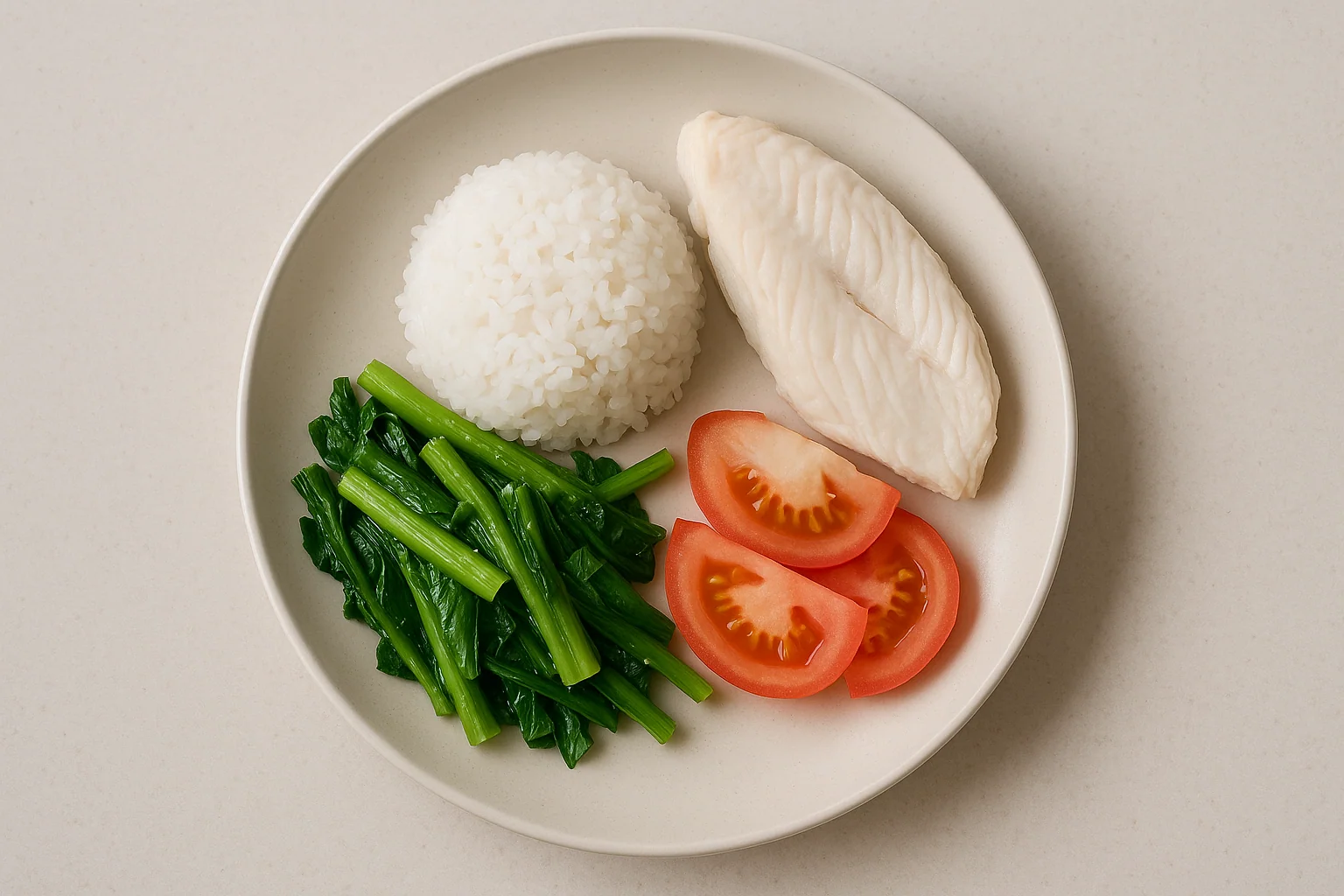
A simple framework for choosing hawker meals on a weight-loss plan
You don't need a calorie tracker for every meal if you have a few rules of thumb. The framework below covers most situations.
The 30/20/half rule
Aim for at least 30g of protein in the meal, at least 20% of the plate as vegetables, and ask for half the default rice on rice-based plates. Applied consistently, this single set of rules pulls most hawker plates into a weight-loss-compatible zone without rebuilding your diet from scratch.
Default to grilled, steamed, or boiled
At any stall offering options, lean toward grilled, steamed, or soup-based versions over fried, wok-fried, or coconut-based. The difference is often 200–400 calories per meal — over a week, that's substantial.
Hold back on the sauce
The sauces, sambals, and chilli oils aren't where the flavour lives — they're concentrated calories. Try the dish first, then add only as much sauce as you need.
Drink water, not bottled drinks
A bottled drink or kopi-o-bing alongside your meal can add 150–250 calories. Plain water, kopi-o without sugar, or teh-o kosong is the easiest swap in the entire framework — and it's the swap most men resist.
When food alone isn't moving the needle
For some men, dietary adjustments and exercise are enough to reach and maintain a healthy weight. For others — especially those with metabolic factors at play, a long history of weight gain, or BMI in the obesity range — diet alone can stall well before a healthy weight is reached.
A doctor in Singapore will usually consider medical weight management when:
- BMI is 27.5 or higher with one or more weight-related conditions (high blood pressure, pre-diabetes, type 2 diabetes, sleep apnoea, fatty liver, high cholesterol)
- BMI is 30 or higher regardless of other conditions
- Sustained lifestyle change over 6 months hasn't produced clinically meaningful weight loss
- There are metabolic or hormonal factors (insulin resistance, low testosterone, hypothyroidism) that make weight loss harder
Medical weight management can include nutritional planning, behavioural support, and — where appropriate — medications such as GLP-1 receptor agonists (semaglutide, tirzepatide and similar). These are prescription-only treatments that work alongside, not instead of, dietary and lifestyle changes. They require a doctor's assessment and ongoing supervision.
Frequently asked questions
Do I have to give up hawker food to lose weight?
No. The men who succeed at sustainable weight loss while eating hawker food adjust composition and frequency rather than removing it entirely. Half the rice, more protein, fewer fried items, lower-calorie drinks. Done consistently, that's enough to create a deficit for most men.
Is there a single "best" hawker dish for weight loss?
Economy rice and yong tau foo are the two most flexible — you choose what goes on the plate, which means you can build a high-protein, lower-calorie meal at almost any stall. The dish itself isn't the answer; the composition is.
How much protein do I actually need?
For an active man trying to lose fat while preserving muscle, 1.6–2.2g per kg of body weight per day is the evidence-supported range. An 80kg man should aim for roughly 130–175g of protein daily. Three hawker meals at 30g of protein each gets you most of the way there.
Should I consider GLP-1 medication?
GLP-1 medications are prescription-only in Singapore and require a doctor's assessment. They're not a starting point — they're a medical option when BMI, comorbidities, and previous attempts make them clinically appropriate. A consultation with a Singapore-licensed doctor is the right way to find out whether they fit your situation.
Can I see a doctor about weight loss online?
Yes. Telemedicine consultations on platforms like Noah cover initial weight-management assessments, planning, and — where appropriate — prescription of medical weight-loss treatment under MOH-licensed clinical oversight.
Bottom line
Hawker food and weight loss aren't incompatible. The men who manage their weight successfully while eating hawker food do it through composition (more protein, less rice, fewer fried items), frequency (lower-load options most days, indulgent ones occasionally), and drink choices (water and unsweetened kopi-o over bottled drinks). For some men, that's enough. For others, medical weight management — including GLP-1 medications where clinically appropriate — adds a meaningful tool to the toolkit.
To book a confidential weight-management consultation with a Singapore-licensed doctor on Noah, start the evaluation when you're ready.
For related reading, see our guide to medical weight loss in Singapore, our overview of GLP-1 weight-loss medications, and our Ozempic cost guide for 2026.
Find out what your BMI indicates
Your BMI indicates that you may be
()
Your estimated weight loss in 1 year*
- kg-9% · kg to kg
BMI provides an estimate of weight classification. For a thorough analysis of your weight and medical options, arrange a teleconsult with a Noah doctor.
*Medical treatment may not be appropriate for you even if you have a high BMI
*In a 72-week clinical trial of 2,539 adults with obesity or overweight (without diabetes), participants taking the highest dose of GLP-1 + GIP alongside diet and exercise.
Reading about it is a good start.
Talking to a doctor is better. Answer a few questions online and a licensed Noah doctor will take it from there, privately.
Get started
Medically reviewed by Noah Clinical Team
Written by our Editorial Team · Last updated 29 May 2026
References
Health Promotion Board Singapore. Energy and Nutrient Composition of Food. (Link)
Phillips SM et al. Protein "requirements" beyond the RDA: implications for optimizing health. Applied Physiology, Nutrition, and Metabolism. 2016;41(5):565-572.
Wilding JPH et al. Once-Weekly Semaglutide in Adults with Overweight or Obesity. NEJM. 2021;384:989-1002.
Ministry of Health Singapore. Clinical Practice Guidelines: Obesity. (Link)
Articles on Noah are for informational purposes only and do not replace medical advice from a qualified doctor. Treatments mentioned require a prescription and a consultation with a Singapore-licensed doctor. To consult on Noah, click here.