Premature Ejaculation
April 7, 2026
·
read

Behavioural Techniques for Premature Ejaculation: Stop-Start, Squeeze & Kegels

Medically reviewed by Dr. Kevin Chua, Medical Director

No items found.

Medically reviewed by Dr. Kevin Chua, Medical Director

Disclaimer: This article provides general information and is not a substitute for professional medical advice.


Introduction

Behavioural techniques are the oldest and most natural approach to managing premature ejaculation. They work by training you to recognise and manage your arousal levels, building the skills needed to delay ejaculation. While they require practice and patience, they can be effective alone or — for many men — work best when combined with medication.


The Stop-Start Technique

Developed by urologist James Semans in 1956, the stop-start technique remains one of the most widely recommended behavioural approaches for PE. It teaches awareness and control over the ejaculatory reflex.

How It Works

The goal is to learn to recognise the "point of no return" — the moment just before ejaculation becomes inevitable — and to stop stimulation before reaching it.

Step-by-Step (Solo Practice)

  1. Begin self-stimulation at a comfortable pace
  2. Focus on arousal levels — rate your arousal on a 1–10 scale (10 = ejaculation)
  3. Stop at level 7–8 — pause all stimulation
  4. Wait 30–60 seconds until arousal drops to level 4–5
  5. Resume stimulation and repeat the cycle
  6. Practice 3–4 stop-start cycles before allowing ejaculation
  7. Repeat 3–4 times per week for several weeks

Step-by-Step (With Partner)

  1. Follow the same principle during partnered sexual activity
  2. Communicate with your partner — signals or verbal cues
  3. When approaching the threshold, pause or switch to an activity that reduces stimulation
  4. Resume when arousal decreases
  5. Gradually extend the time between stops as control improves

Tips for Success

  • Practice consistently — sporadic attempts won't build the neural pathways needed
  • Start solo before incorporating a partner
  • Don't view pauses as failure — they're the technique working
  • Combine with deep breathing — slow, diaphragmatic breathing activates the parasympathetic nervous system

The Squeeze Technique

Developed by Masters and Johnson (1970), the squeeze technique adds physical compression to the stop-start approach, providing an additional tool for interrupting the ejaculatory reflex.

How It Works

When approaching ejaculation, firm pressure is applied to the penis, which temporarily reduces the urge to ejaculate by compressing the urethra and altering neural signalling.

Step-by-Step

  1. Stimulate until approaching the point of no return
  2. Stop stimulation completely
  3. Apply firm pressure with thumb and first two fingers:
  4. Option A: Squeeze the glans (head) just below the ridge
  5. Option B: Squeeze the base of the penis shaft
  6. Hold for 10–20 seconds until the urge to ejaculate subsides
  7. Wait 30 seconds, then resume stimulation
  8. Repeat 3–4 times before allowing ejaculation

Important Notes

  • The squeeze should be firm but not painful
  • You may partially lose your erection during the squeeze — this is normal and expected
  • Partner involvement is ideal — they can apply the squeeze while you focus on arousal awareness
  • Erection typically returns quickly after releasing the squeeze

Pelvic Floor Exercises (Kegels)

Pelvic floor muscle training is a newer but promising approach to PE management. The pelvic floor muscles (particularly the bulbocavernosus and ischiocavernosus) play a role in the ejaculatory reflex.

Evidence

A small but encouraging body of research suggests that pelvic floor rehabilitation can improve ejaculatory control. Strengthening these muscles gives you greater ability to voluntarily contract them before ejaculation, providing a "braking" effect(Based on MOH guidelines and prescribing information).

How to Find Your Pelvic Floor Muscles

  1. During urination, try to stop the flow mid-stream — the muscles you contract are your pelvic floor muscles
  2. Alternatively, try to tighten the muscles that would prevent passing gas
  3. Without tensing your abdomen, buttocks, or thighs — isolate the pelvic floor

Exercise Programme

Exercise Reps Sets Frequency
Quick contractions (squeeze and release) 10 3 Daily
Sustained holds (squeeze and hold 5 sec) 10 3 Daily
Long holds (squeeze and hold 10 sec) 5 3 Daily (advanced)

Timeline

  • Weeks 1–2: Learn to isolate the correct muscles
  • Weeks 2–4: Build strength with consistent practice
  • Weeks 4–8: Begin to notice improved control during sex
  • Weeks 8–12: Meaningful improvement in ejaculatory latency

Combining Techniques with Medication

The most effective approach for many men combines behavioural techniques with pharmacological treatment.

Why Combination Works Best

  • Medication provides immediate improvement, reducing performance anxiety
  • Behavioural techniques build long-term skills and neural pathways
  • Medication may be reduced or discontinued once behavioural control improves
  • The skills learned through practice persist even after stopping medication
  1. Start medication for immediate relief and anxiety reduction
  2. Begin behavioural practice simultaneously
  3. Practice consistently for 8–12 weeks
  4. Gradually reduce medication if behavioural control is sufficient
  5. Maintain practice for ongoing benefit

Cost in Singapore (SGD)

PE treatment is relatively affordable. Dapoxetine (generic) costs approximately SGD $5–15 per dose, while branded Priligy is slightly more. Daily SSRIs used off-label for PE cost SGD $15–40 per month (generic). noah™ PE treatment plans start from SGD $40/month including consultation and medication.

Prices are approximate and may vary. Updated April 2026.

FAQ

1. How long until behavioural techniques work?

Most men notice some improvement within 2–4 weeks of consistent practice. Meaningful control typically develops over 8–12 weeks. Unlike medication, the skills you build through practice can provide lasting benefit.

2. Can I practice alone or do I need a partner?

Solo practice is an excellent starting point and is actually recommended before incorporating a partner. You can build awareness and control through self-stimulation before applying the techniques during partnered sex.

3. Will pausing ruin the mood?

With communication and practice, pauses become natural and can even enhance intimacy. Many couples incorporate pauses into foreplay or position changes. Your partner's understanding and support significantly improve outcomes.

4. Do Kegel exercises really work for PE?

The evidence is preliminary but promising. Pelvic floor exercises are low-risk, free, and may provide meaningful benefit for some men. They work best as part of a comprehensive approach.

5. What if techniques alone aren't enough?

That's completely normal — many men benefit from combining behavioural techniques with medication. There's no failure in needing pharmacological support. The goal is finding the combination that works for you.


→ Return to pillar: Complete Guide to PE Treatment in Singapore

This article is for informational purposes only and does not constitute medical advice. Always consult a licensed doctor before starting any treatment.
Find out what your BMI indicates

Your BMI indicates that you may be
Slider
BMI provides an estimate of weight classification. For a thorough analysis of your weight and medical options, arrange a teleconsult with a Noah doctor.

*Medical treatment may not be appropriate for you even if you have a high BMI
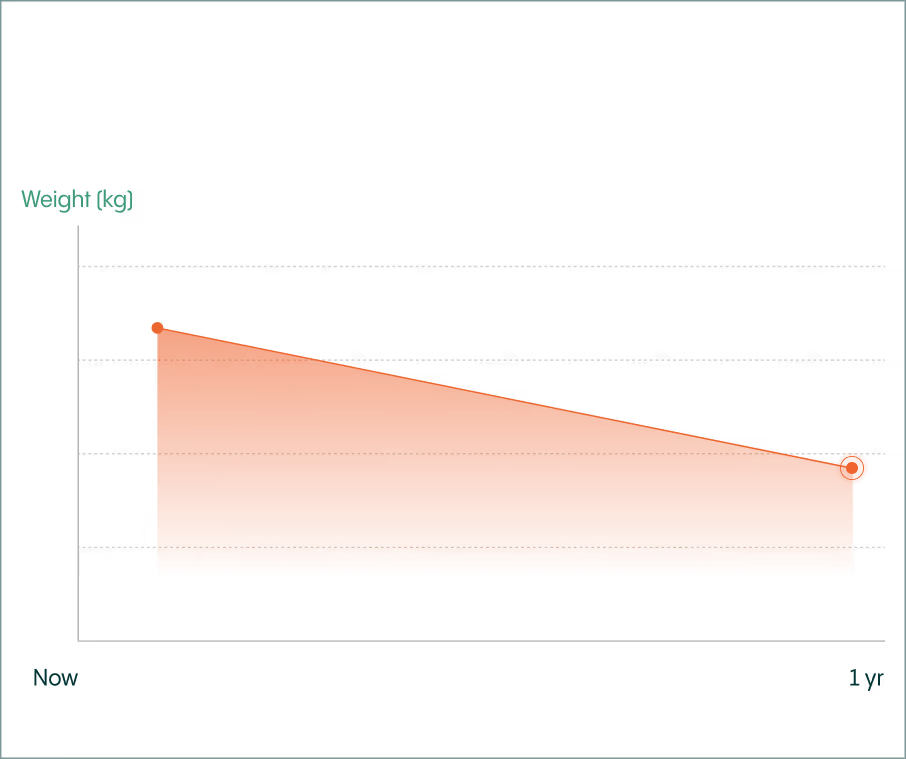
Your estimated weight loss in 1 year*
-
00
kg
-9%
90
kg
78
kg
99
81
63
Weight loss progress graph on transparent background showing treatment results
*In a 56-week trial with 3,731 non-diabetic overweight (BMI ≥27) or obese (BMI ≥30) participants, those who finished (1,812 patients) lost an average of 9.2% body weight with Saxenda, alongside diet and exercise.
No items found.
Written by our Editorial Team
Last updated
7/4/2026
disclaimer

Articles featured on Noah are for informational purposes only and should not be constituted as medical advice, diagnosis or treatment. If you have any medical questions or concerns, please talk to your healthcare provider.